Guin Saga (#2-5): The Marches Episode, Hungry like the leopard.

Well done serial adventures like Flash Gordan and the Lone Ranger work best if they are addictive. They should engage the audience in a way that even after giving you some amount of resolution keeps you coming back again and again. Guin Saga is no exception to this rule, the first book tells a complete story but it is a very small piece in the grandiose epic of Guin discovering who he is, what he was meant to do, and being totally awesome while he does it. The next four books keeps up the constant forward momentum of Guin and his companions in the next leg of the journey. When you finish one book you will often be surprised how quickly you find yourself wanting to move on to the next.

Once I got my hands on the rest of the Guin books released from Vertical, it was a short time before I was finished and wanting more. We decided to review the rest of the Marches Episode of Guin together because a lot that is going on is very transitional especially in the second and third installments. This is by no means a complaint or a determent to the series, it is just a fact in a multiple volume story that some books will fall into this section of moving the story along without having any huge incidents. However, Kaoru Kurimoto is able to keep you on your toes the entire time with a rapid pace and varying points of view.

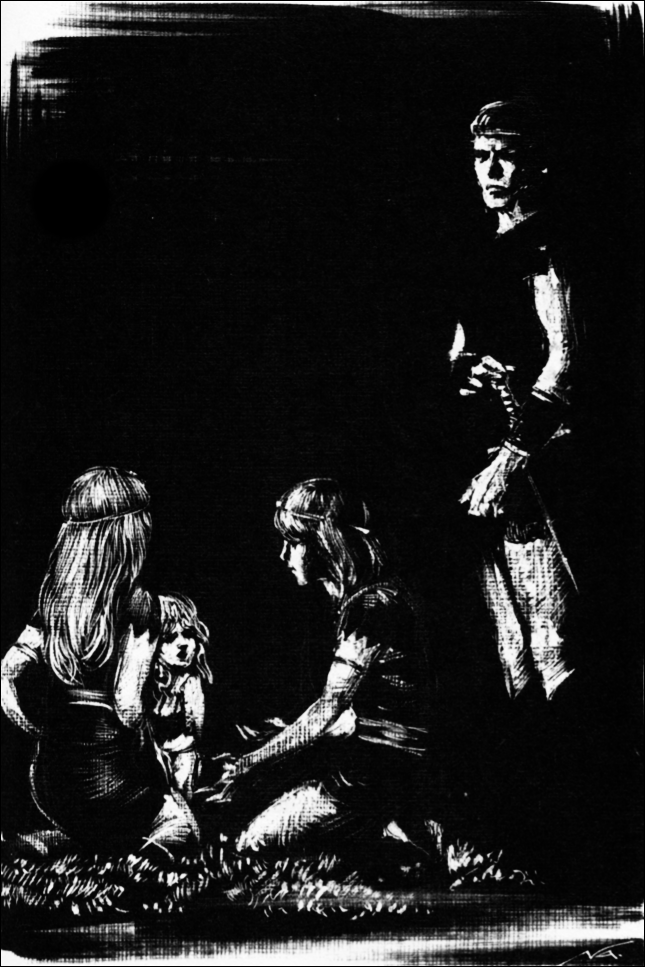
Like an good serial adventure we ended with our heroes in mortal peril (i.e. jumping into the churning waters of the deadly Kes River) after escaping the castle of the Black Count. They obviously survive the fall and soon find themselves with Istavan Spellsword running into the twisted wasteland known as Nospherus. Guin and company soon find themselves between the monstrous denizens of Nospherus and a large contingent of Mongauli soldiers led by the beautiful Lady Amnelis. Guin must find a way to marshal the inhabitants of Nospherus to drive off the army intent on killing them all, taking the twins of Parros, and annexing the wastelands. Guin is outnumbered and outgunned but he’s Guin, fate would not have it any other way.

It becomes quite clear as our band of heroes makes their escape from the Monguali army that Nospherus is a hellish place. However, as they start to understand it, they begin to use it to their distinct advantage with the help of the Sem barbarian tribes. Even though Guin is on the side of the Sem (and really all the inhabitants of Nospherus) it is always an uphill battle that requires cunning, supreme strategy, and a bit of fate’s guidance. The final battle still had a lot of surprises in store and while the overall outcome was what I expected, getting there and what was sacrificed was not. Once again the storytelling of Guin Saga really shines when it can lead you to understand characters but not predict the entire story to follow.
Continue reading

Ongoing Investigations: Case #056

A bunch of us finally caught (no pun intended) Ponyo on the Cliff by the Sea over the weekend. It starts with the basic premise of Ponyo, a little goldfish, who escapes her father’s ship and rides to the surface out of curiosity but she is foiled by a bottle she gets stuck in. Once a young boy named Sousuke rescues and carries around the stranded Ponyo for a day, she is hooked and decides to become human. Sousuke and Ponyo’s relationship is very sweet and innocent as one could imagine. There are some very magical moments as Ponyo, along with her father who wishes to purify the oceans, and her mother all possess powerful abilities and when they are used they create some of the most beautiful parts of the film. An unsurprising fact is that this film has some very visually striking moments, but surprisingly the animation quality for many parts of the movie seemed less than Ghibli-esque. My biggest concern with the film was Miyazaki’s decision to essentially throw out some of the narrative and conflict on a whim and then to tie it up with a less than satisfactory climax to the story. In fact, I can’t really discern any climax at all. About two-thirds of the way through any amount of suspense starts to dissipate and the rest of the film is rather meandering and boring. Ponyo loses its momentum and refuses to deliver on the build-up it created for a good portion of the film. While I found some of the visuals quite appealing, the story was rather lack luster and in the end that matters much more.

As has been said many times, Miyazaki needed someone to stand up to him and keep him in check. This could have gone from an okay film to a Ghibli master work had someone had the bravery and power to make this film go through one or two more retoolings to tie everything together. The ending was extremely anticlimactic causing one to wonder if Miyazaki tired of the story and decided to just end it as soon as he could much like a Neal Stephenson novel. They made such a big deal that Ponyo’s parents wanted to test Sousuke and Ponyo’s love but in the end it comes down to a simple: Do you like Ponyo? Check yes, no, or maybe. The test did not need to be hard or dangerous, it just need to be one Sousuke could fail because that makes things not only dramatic but cathartic when they are overcome. Ponyo’s mother could have made duplicate Ponyo’s and see it Sousuke could tell the real one apart. Or maybe Sousuke could have to make some sort or moral judgment due to a test set up by Ponyo’s parents but was unaware he was being tested. Overall the movie looks great and is really fun at many points, like when the typhoon comes, but it does not work as a cohesive narrative film. The characters had a lot of potential that was partially realized but never truly developed. It’s worth a rent to take in the visuals but not worth buying.  Hopefully if Miyazaki makes another film he will let people help him cut out what is extraneous and focus on what is important.

I am very excited to present the latest piece of art we had commissioned at AnimeNEXT! It is by syun rii who does many different styles for her fanart. I really wanted something chibi so I think she was the perfect choice! You can check out her gallery, too.

Continue reading

The thin line between moe and masturbation.

Talking about moe was the third article we ever did for the blog. Moe is, for a wide variety of reasons, a topic that Narutaki is forced to discuss and debate with me on a regular basis. So this is an article that has been fermenting in our minds for quite awhile. A small discussion about the nature of moe and sexuality broke out on twitter. Scott VonSchilling was arguing that moe and sexuality are separate traits and should not be considered connected. I then used one example that turned the whole conversation into a fire storm of debate, Mikuru Asahina. She is a character who is famous for being extremely moe and extremely sexualized but more importantly sexualized for and by her moe. The conversation quickly spiraled out of anyone’s control.

It has been many moons since we last discussed this growing term and I don’t even remember what spurned on our first article. I honestly try to avoid such discussions when I can, it’s true but it still comes up pretty often whether I see it on Twitter or on a bus ride to Otakon. Sometimes I participate and sometimes I just take in the discussion going on around me. Moe, everyone’s got an opinion about it so what we are adding here is not just our overall perspective on the genre/term/thing, but rather a specific instance of it.

As I mentioned in our Otakon 2009 report I am still not sure people in the anime business in Japan comprehend the full meaning of moe let alone anyone else. I am better at defining what moe is and detecting it when it exists in a show but on the other hand I am still light years away from a perfect understanding or acceptance of the term. As far as I can tell moe has maintained its bizarre dual meaning. In a general sense it means an attraction and devotion to any trait. You can be moe for maids with glasses, blond boys who are in gangs, or curry joints that serve their dishes on trains. In a more specific, pure, and otaku sense it means the desire to protect weak characters that cannot protect themselves. In its ideal and stated definition there is no sexuality in moe. You want to protect the moe character and have a chaste love for them. Some describe it as a fatherly need to protect and nurture someone weaker. This more specific definition is the one that causes the most problems and is the focus of the discussion.

Up until a couple of years ago I had no idea this word even existed or held a place in fandom. Obviously, since then a lot of anime watching has happened, a lot of reading has gone on, and numerous discussion have taken place and still there is no consensus on what exactly moe is. Luckily, we are telling you which popular theory of the word is up for debate. Moe is about security and affection given through supporting and protecting a character who for some reason can’t do so on their own. There are a myriad of reasons why characters exude this need. Despite the many things I could say about this scenario (and the many problems that arise), they aren’t all relevant to this particular discussion. It’s worth noting that while some moe characters are very young, many fall into the high school age so always equating moe and lolicon is a stretch even though that is a popular assumption. And by extension moe does appeal to the lolicon crowd. However, what is important for the current theory we are undertaking is that the characters aren’t supposed to elicit eroticism but rather endearment.

Continue reading