
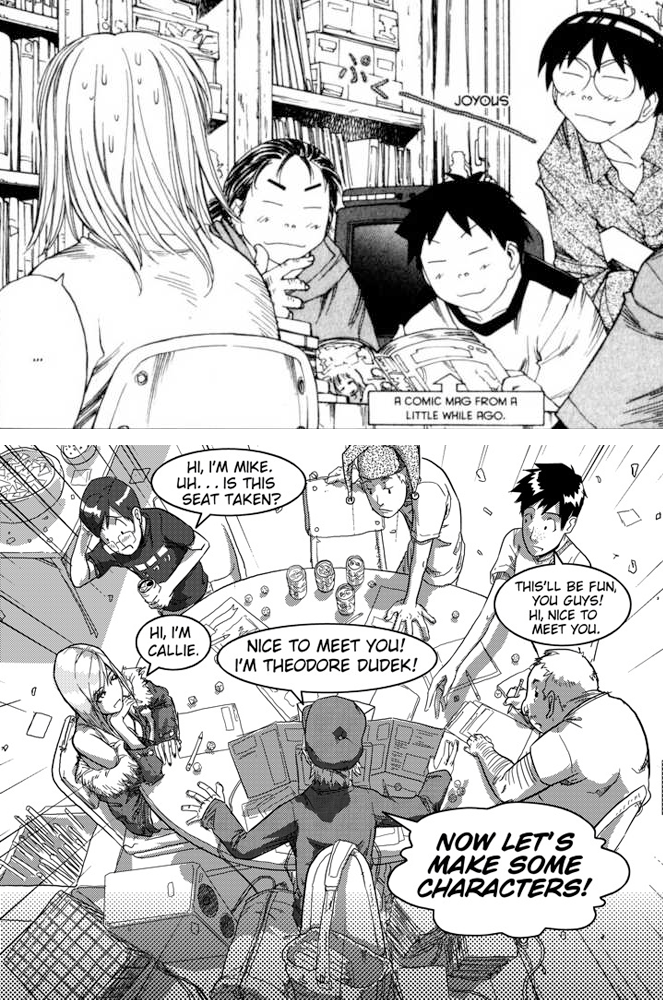
 We got a copy of Foiled from First Second Books last week, I was rather excited because it was penned by Jane Yolen! Her imagination and description would surely lend itself to being made into a comic. Just as I hoped, Mike Cavallaro achieved it wonderfully. The art style is this wonderful hybrid between comics and American cartoons. Aleria isn’t a typical teen-aged girl with her kind of rye look at the world, but she is quite relateable in her semi-awkwardness, slightly odd parents, and geeky slant but no real place to fit in. In fact, all of these make her more alive than some exaggerated contemporaries, nothing is totally normal but nothing is too off the wall in her life. But what sets her apart (even more?), besides her attitude, is that she is a fencer and a very good one at that. And of course that is where the story really begins and ends as her latest fencing sword (or as she would yell WEAPON!) was a thrift store find with a weird jewel on the hilt. Throw in a new boy at school, some table top role-playing, and the appearance of a world that rests on top of NYC chockful of mystical creatures and you have a wonderful, fun, and magically little book. The magical world is such a strong element, but it doesn’t really come to the forefront till more than half way through. This was really my only complaint, yes it is important to establish Aleria’s (what she would call) mundane, every day life but with only one book you really want to have the fun of the other world sooner. So this should be remedied by making a sequel!
 The first thing that popped into my mind when I read Foiled was Neil Gaiman’s Neverwhere (and I loved Neverwhere). Not that the average but slightly extraordinary person who learns that there is magical world underneath the mundane world is a utterly unused storyline but the allure is one that makes it an evergreen concept. Jane Yolen takes this old framework and writes an excellent story for young girls as well as a good fantasy story in general. Aliera is a great protagonist who is a strong female character but vulnerable and awkward enough to be easily identifiable. Her passion for fencing and the way it integrates into the story on both a storyline level and a symbolic level give it a smart feeling while also giving it a cool energy. I especially liked how each of the chapter titles used a fencing term with accompanying art that set the tone for the chapter. I will agree with Narutaki that for a single book story they could have picked up the pace in introducing us to the magical world. It’s not that the beginning should be cut short but I too would have liked to see the fantasy elements pop-up earlier. If nothing else it proves that the story is begging to be turned into something longer.
I received the first book of My Darling! Miss Bancho from CMX this week. The story revolves around the ridiculous (which the manga-ka freely admits) reverse harem that occurs when Souka transfers into a tech school filled with nothing but male delinquents. On one of her first days she accidentally takes down the bancho (boss/gang leader) of the school and by their rules that now makes her the new bancho. Cue wacky antics. The story so far is a fairly amusing series of sillyness mixed with some shojo cliches. I felt he pacing was a little off, especially getting the whole ball rolling, maybe it’s just personal taste but it would probably serve the story, and the humor better, to have her take out the school’s bancho right in the first few pages. Just about every guy in her class is enamored with her (and the entire school is pretty much bowing down to her and hoping for her favor) so she gains a couple of minions who act equal parts crazy and devoted. The main love interest is the leader of the sophomores, Katou, who is sort of a mother hen to the rest of the guys and vows to protect Souka. Souka is kind of a middle-ground heroine so she isn’t too engaging unfortunately. Despite the fact that she takes out the previous bancho, she isn’t particularly tough or feisty, if she were this story might be pushed to more funny heights. So really, while amusing and having its good moments, My Darling! Miss Bancho doesn’t really push its silly premise far enough to make it a rip-roaring good time.
 And so ends
  The beginning of The Color of Heaven starts very somberly as Ehwa is separated from Duksam and knows not when he will return. The first two book build up to this point of falling truly in love, so the third has a lot of quiet moments of introspection and realization. Also about half of the book involves waiting and waiting. However, that isn’t to say it is boring, much to the credit of the author, the growth between mother and daughter is subtle and beautiful. Ehwa’s mother is a woman who knows through maturity the power of longing and waiting and she imparts many important lessons on Ehwa in this final volume. In fact, much of this concluding story seems to be as much about her mother as it is about Ehwa. But perhaps even more telling is Ehwa’s ability to understand these lessons while still maintaining a hint of her naivete when it comes to the relationships between man and woman unlike her moments in the first two book. What becomes increasingly obvious through various conversations with her friend and mother is Ehwa’s ability to emotionally understand herself and her love but not to physically understand the relationships between the sexes. The finally moments of the book play out between Ehwa and Duksam while being interspersed with her mother and the picture man and also a set of neighbors. And you feel her education while not complete has finally gotten to a new plateau. The Color series has been both artistically unique and calmly enthralling and as such is a series that needs to be read and experienced.
 Reverse Thieves