Ongoing Investigations: Case #182

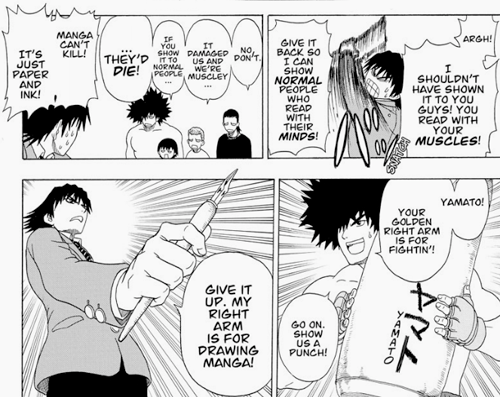
The newest series running in Shonen Jump Alpha, and brand new in Japan as well, is Takama-ga-hara. The series poses the idea “If mythology was actually history, then modern man is descended from the Gods.” And since it is a Shonen Jump manga you can expect they use their God-like powers for fighting. People don’t seem to be aware of this fact about being descended from Gods yet, but nevertheless there are the infamous Yamada brothers known for their pursuit of strength!

Except Yamato. He doesn’t want to train and be strong like the other four Yamada brothers, he wants to be a manga artist instead. Too bad the rest of the world wants to challenge him to fights since he is a Yamada.

Takama-ga-hara had me cracking up within the first few pages! The brothers have great interactions and their brawn VS. brain rivalry created hilarious moments. Also characters’ reactions to Yamato’s presumably terrible manga are priceless.

We haven’t really jumped into the God part of the story within the first chapter. The opponent is just a really big, strong delinquent guy who wants to make a name for himself. Although, we do see that Yamato’s right arm holds incredible strength that is dying to be unleashed.

The art isn’t very polished or detailed (minus speed lines), but it has solid layout and great comedic delivery. And as long as it keeps me laughing like this first chapter, I’m on board for more.

I would like to update by recommendation for Yamada and the Seven Witches as Manga of the Month with this Ongoing Investigation. I originally said the series was a body swap comedy but I was waiting for the other shoe to drop when the full meaning of the title was revealed. Now that Miki Yoshikawa has revealed more of what is going on I must reassess my statement about the series. It is actually a magical kiss power series where one of the powers is body swapping.

I have to say I am always impressed by the way that Miki Yoshikawa creates series that have an always evolving plot especially in chapters 16 to 26. So much comedy tends to move in the same circles for a majority of the story. I don’t mind that formula too much. As long as the comedy makes me laugh I am content. But with a series like this I have to admire the ability to keep the themes and tone consistent but have a feeling of progression and accomplishment when so much comedy manga is about preventing that. Bravo.

Now that we know that the seven witches are seven different people at school how have kiss powers the plot is beginning to true take form. The series is more about finding the remaining witches and learning how his phenomenon came to be in the first place. Since Ryu is like a Final Fantasy Tactics mime I am curious to see how he will use his new-found powers as much as what the other witch’s powers are in the first place. Fun.

I will also note that as Narutaki mentioned to me it is so unusual for a shonen series to have so much kissing. Any and all kisses are usually huge deals in the genre. But here any and all genders of characters are kissing like most people just say hello. It is just a bit remarkable in that sense.

Urara Shiraishi impresses me as being sufficiently different from Hana Adachi but also a great character in her own way. You can easily accuse Ryu Yamada of just being the Daichi Shinagawa clone of the series but Urara really comes of as unique. She is clearly book smart but also the clearest thinker in the series. Her main problems are big physically weak and very poor at grasping social cues. But she has a social awkwardness very different from Hana. My only regret is that she is a very closed off character so at times Miki Yoshikawa keeps her in the background least the overexpose her feelings and thoughts.

Once again if you don’t mind scans or can read Japanese you should be at least trying out Miki Yoshikawa. She is just that good.

The Ongoing Investigations are little peeks into what we are watching and reading outside of our main posts on the blog. We each pick three things that we were interested in a week and talk a bit about them. There is often not much rhyme or reason to what we pick. They are just the most interesting things we saw since the last Ongoing Investigation.

Continue reading

Ongoing Investigations: Case #179

There are some books that are supposed to be the definitive word on the subject right out of the gate. They define a topic and then create an iron clad thesis around themselves daring all to dare try to assail their academic Super-Alloy Z fortress. Other books present an idea and then open it up for further discussion with the material presented within being a catalyst for a new perspective. Benjamin Nugent’s American Nerd: The Story of My People is more in the second category than the first.

The book looks into what has makes the modern nerd both internally and externally. That means everything from the historical forces that turned the intellectual and social outcasts of the past into the modern dweeb, the simple etymology of the word nerd, to the personal forces that determine one is a nerd as opposed to any other label one could be thrown under in life. There is also an examination of the various factions of nerdery that exists today as well as some personal memoirs to give things an authentic weight.

Since Benjamin Nugent confesses to at one time be a fairly heavy computer and D&D nerd that is where a good deal of the in-depth analysis lies. There is also a bit of focus of SCA and science fiction geeks as well. Because this is still the Reverse Thieves blog and not the All Geeks Considered website I must mention that while Japanese otaku and American anime fans come up they are more footnotes than anything else. There is a small chapter about the author going to an Anime con and a bit on yaoi they are more just casual mentions. It is called American Nerd so it mostly focuses on American based nerdy pastimes. Self hating American anime fans can read all they wish into that.

But speaking of self hating nerds they is a details look at both the classic jocks vs. nerds battle as well as the self loathing that geek heap upon themselves. It is a fascinating look into how the nerd deals with opposition just as fierce from within as from without.

The book is hardly perfect. For as many geek cliques as the book examines it leaves out twice as many. And those groups it does cover are hardly done in any depth. Also I would have been very curious for him to examine the fact that the most savage enemies of nerds are often other nerds from different camps. The old Geek Social Hierarchy Chart sums that up better than I ever could. Heck I have had 4 conversations recently about how the once united kingdoms of fantasy and sci-fi have grown into separate armies with a great deal of animosity between them. And most of all I just disagree with some of the conclusions he proposes. Some of his links to racial and religious prejudices in the past to nerdy prejudices in the present seem suspect.

But in the end it is all forgivable because this is not supposed to be Tablets of Stone from Mount Sinai of Nerdom (or should I say Tablets of Mythril from Mount Gundabad.) It is supposed to get your brain to think about nerds beyond the normal jocks vs. nerds hierarchy. In that regard I think it succeeds for both people who know nerds and those who are neck-deep as well. And that is reason enough to give the book a once over.

Picked up American Nerd randomly because the name caught my eye. It is part memoir, part theory, part discussion starter about the origin and lifestyles of nerds in the U.S. It touches on everything from where the word “nerd” may have started and how it became part of the vernacular; to the divide between emotional thought and rational thought; to observations of various nerd events.

One section I really enjoyed was about the situational nerds who are pushed into the nerd category because of that grand social hierarchy where someone must be on the outside. But many of these people don’t have the traditional personality types of nerds. This resonated with me personally.

He has quite a few bits about anime culture though you could tell that he wasn’t all that familiar with it on a one to one scale as he was with something like D&D. Some of the more interesting bits were about observing how Asians had become synonymous with nerds on a few levels. He also talked about the link between Japanese culture and nerdom starting with cyber punk and technology in the early 80s. I realized that though the links between nerds and Japan have changed over the years (less to do with sci-fi for example), that association of Japan as a geek paradise is still there. You see this in news reports as well as anime fandom.

I enjoyed the book and I didn’t feel like he was putting forth his ideas as the gospel. There were parts that struck me as odd like the section about polygamists, but overall I found a lot of interesting discussions can come out of this book. Especially if you are a nerd.

Continue reading

Ongoing Investigations: Case #178

I like nerdy documentaries, even if (or maybe especially if) they are about hobbies that I only just have knowledge of. Afterall, that seems like what documentaries are for, learning. So when I saw the trailer for Indie Game: The Movie, I knew I wanted to see this movie.

I am not much of a gamer and I’ve never played or even knew about any of the games in this movies, but that isn’t important. What matters is the connection they build with the audience as we watch and hope for their success. Though if you do know the games a bit of the suspense is taken away, still the filmmakers do a great job of building the tension regardless of their outcome.

To me, the movie is about three tortured artists and one guy who loves games. IGtM really shocked me with how delicate the balance of these developers walk, teetering on the edge of losing their sanity and being penniless. They truly are like painters desperate for success, acknowledgment, and a paycheck. By their own admissions, they were likely to do something rash should these games fail at this point.

And then there was Edmund, the guy who loves game which I mentioned. Thank God he was in this movie to ground the entire thing otherwise it would have been a real downer. Edmund is tired, brain drained, and worried about money but he is also excited for his game with a positive energy about him. It came across clearly how much Edmund loves video games and the movie needed that. The other guys clearly loved their games too, otherwise they could never dedicate so much of themselves to it, but they let the fun be taken from them whereas Edmund still shows that joy.

I would have liked to see more about the community surrounding indie games. They mention a few little things off-hand, like Johnathan Blow responding to any comment anywhere on the net about Braid, but overall they don’t give the community a real voice in the movie. I assume they are an important aspect, and seeing a player talk about and waiting for a game would have been a nice touch.

I really enjoyed this documentary, I felt that sense of impending doom as the approaching release date of Super Meat Boy; I felt the heartbreak of a glitchy demo with Fez. I don’t know much of anything about indie games, but now I know that the phrase “this isn’t as easy as it looks” applies to this scene like so many others.

I had been interested to see Indie Game: The Movie ever since I heard about it when it was raising funds through Kickstarter. Like most nerds the creation of video games has always been an intriguing process but indie games in particular have a much more raw and personal feel. Plus indie games, sort of like writing a book, is something a lot people secretly want to believe that if they just sat down and really put in a crazy effort they could do themselves. And much like writing a book for most people it is something that mostly remains a theoretical concept or an eternally barely started project.

This documentary does provide a remarkable amount of insight into the chunk of your soul that goes into making any decently ambitious indie game. It very clear how much time and energy goes into making a game and how perilous it can all seem. None of the people profiled has large teams or companies backing them up. That sense that these guys were taking a real risk to follow their dreams was very apparent.

The contrast between the two guys working on Super Meat Boy was fairly interesting. Edmund McMillen seemed fairly positive and energetic whereas Tommy Refenes seemed very dour about the whole project. It sort of reminded me of another duo. Edmund McMillen game philosophy and off beat sensibility seems the sort of aesthetic that would only be allowed in an independent environment. But overall despite several setbacks and grueling deadlines Super Meat Boy eventually crosses the finish line as a winner.

Fez on the other hand seemed more like proof that Murphy’s Law always finds a way. Phil Fish’s story seems to be more about how every time he gets somewhere it seems like there is a bear trap waiting for him here. When he tries to show off the latest demo of his game at PAX he has a major legal snafu with an ex business partner it only gets cleared up so he can realize that the demo he is presenting is very buggy. So he is forced to baby the machines running the demos for no end of agita. I will say that Phil Fish did come of as slightly unhinged. Not “he needs to be locked up” crazy but definitely “we only invite him to certain parties with certain people” nutty.

I do have to agree with the guys from Fast Karate. Jonathan Blow does come off as an enormous tool. Especially in contrast to the other creators who are profiled in the movie that really seem to have to pay a pound of flesh for their creations.

Overall I think while the documentary did focus on projects that came out on top it did present the struggle fairly well. I think it also proved that very often more than anything these indie game’s worst enemies could be themselves. With often no one rein them in they can get absorbed in the minutia and lose site of the grander picture. At a professional studio there is usually someone to keep the creative types in line. But without that a vital limiter projects can spin their wheels with no one to just pull the trigger and say “good enough.” That can lead to unique products but seemingly with much wasted energy. It seemed like the people in documentary got the most done when they were under the gun to get something out for an event.

It reminded me a lot of the eternal delays on Type-Moon games. With no one to keep Nasu in check the games seem to take forever as it always seems something can be tweaked or fiddled with. The vitriol from the fans about those delays was also the same in both cases.

The biggest complaint I usually hear about the movie is that it only focuses on success stories. It did seem like they picked games that already had a decent amount of buzz for the film. They did not pick any one who was a complete unknown and all three games profiled were big successes when they were finally released. Considering how many indie games never go anywhere I know some people felt the documentary made it seem like all you needed was an idea and some hard work to be a success.

Might the documentary shown a bit more of the struggling  indie game developer? Sure. In fact I think that would make an excellent follow-up documentary by either James Swirsky and Lisanne Pajot or someone else who wishes to follow in their footsteps. But what is presented here is a fascinating insight to what goes into making a game outside of a major studio. It will crush some people’s casual dreams but strengthen others.

Continue reading