Ongoing Investigations: Case #182

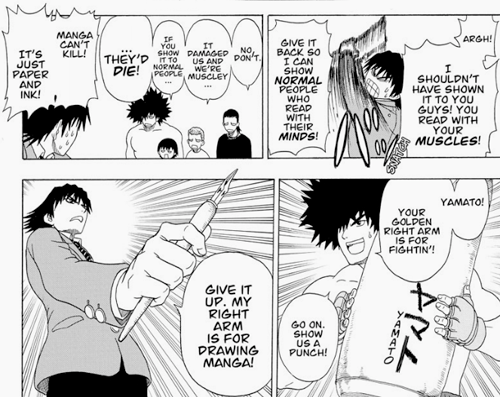
The newest series running in Shonen Jump Alpha, and brand new in Japan as well, is Takama-ga-hara. The series poses the idea “If mythology was actually history, then modern man is descended from the Gods.” And since it is a Shonen Jump manga you can expect they use their God-like powers for fighting. People don’t seem to be aware of this fact about being descended from Gods yet, but nevertheless there are the infamous Yamada brothers known for their pursuit of strength!

Except Yamato. He doesn’t want to train and be strong like the other four Yamada brothers, he wants to be a manga artist instead. Too bad the rest of the world wants to challenge him to fights since he is a Yamada.

Takama-ga-hara had me cracking up within the first few pages! The brothers have great interactions and their brawn VS. brain rivalry created hilarious moments. Also characters’ reactions to Yamato’s presumably terrible manga are priceless.

We haven’t really jumped into the God part of the story within the first chapter. The opponent is just a really big, strong delinquent guy who wants to make a name for himself. Although, we do see that Yamato’s right arm holds incredible strength that is dying to be unleashed.

The art isn’t very polished or detailed (minus speed lines), but it has solid layout and great comedic delivery. And as long as it keeps me laughing like this first chapter, I’m on board for more.

I would like to update by recommendation for Yamada and the Seven Witches as Manga of the Month with this Ongoing Investigation. I originally said the series was a body swap comedy but I was waiting for the other shoe to drop when the full meaning of the title was revealed. Now that Miki Yoshikawa has revealed more of what is going on I must reassess my statement about the series. It is actually a magical kiss power series where one of the powers is body swapping.

I have to say I am always impressed by the way that Miki Yoshikawa creates series that have an always evolving plot especially in chapters 16 to 26. So much comedy tends to move in the same circles for a majority of the story. I don’t mind that formula too much. As long as the comedy makes me laugh I am content. But with a series like this I have to admire the ability to keep the themes and tone consistent but have a feeling of progression and accomplishment when so much comedy manga is about preventing that. Bravo.

Now that we know that the seven witches are seven different people at school how have kiss powers the plot is beginning to true take form. The series is more about finding the remaining witches and learning how his phenomenon came to be in the first place. Since Ryu is like a Final Fantasy Tactics mime I am curious to see how he will use his new-found powers as much as what the other witch’s powers are in the first place. Fun.

I will also note that as Narutaki mentioned to me it is so unusual for a shonen series to have so much kissing. Any and all kisses are usually huge deals in the genre. But here any and all genders of characters are kissing like most people just say hello. It is just a bit remarkable in that sense.

Urara Shiraishi impresses me as being sufficiently different from Hana Adachi but also a great character in her own way. You can easily accuse Ryu Yamada of just being the Daichi Shinagawa clone of the series but Urara really comes of as unique. She is clearly book smart but also the clearest thinker in the series. Her main problems are big physically weak and very poor at grasping social cues. But she has a social awkwardness very different from Hana. My only regret is that she is a very closed off character so at times Miki Yoshikawa keeps her in the background least the overexpose her feelings and thoughts.

Once again if you don’t mind scans or can read Japanese you should be at least trying out Miki Yoshikawa. She is just that good.

The Ongoing Investigations are little peeks into what we are watching and reading outside of our main posts on the blog. We each pick three things that we were interested in a week and talk a bit about them. There is often not much rhyme or reason to what we pick. They are just the most interesting things we saw since the last Ongoing Investigation.
Continue reading

From Rags to Riches, From Pilot to Series

The first chapter of any manga we see rarely anything close to the preliminary draft of the same manga concept. You usually only get one chance to make a first impression so manga artists and their editors tweak, refine, trim their initial ideas that start rather rough around the edges until they are lean, mean, long-term series generating machines. The rougher drafts of existing work are often lost to the sea of time and then mostly only mentioned off handily in interviews. But on occasion we get to see behind the curtain when one-shots are published either to test the waters on a series or as a special treat for an existing series (or to fill some space in a tankobon).

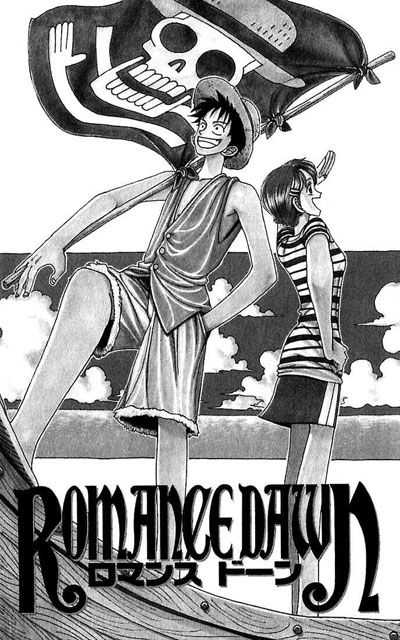
There are three published version of Romance Dawn which eventually we go on to be the series we know as One Piece today. While the overall premise is instantly recognizable you can see the slow evolution of the concepts that would eventually become the finished product that is one of the best-selling comics ever. While Luffy and his pirate adventures are a constant not much else is. Main elements of the world are changed or dropped as the series is refined. Elements like witchcarft are removed and the quest for title of King of the Pirates is added. Almost all the chapters have a Nami like character who is absent in the final first chapter and introduced later on in the series. The progression from the initial idea to the polished work is quite intriguing even when we don’t see all the steps involved.

You can see a similar pattern when looking at the initial one-shot release of manga. Often times a popular one-shot manga will be spun off into a full series if the audience is receptive to the idea. That is often the reason to publish many one-shot manga in the first place. This phenomenon is often a good way to see the formative process of an initial concept to a finished product in an in-between stage. Even stories like Rumiko Takahashi’s Those Self Selfish Aliens or Fire Tripper give interesting insights into the full works that would become Urusei Yatsura and Inuyasha. In this post I will be examining two manga and how they evolve from their initial one-shot premiere to their final initial debut as a full-fledged story.

Continue reading

Ongoing Investigations: Case #181

As a fan of Kenjiro Hata I am always interested in the older works. In fact I did a whole article about the evolution of this style two years ago. I got the Japanese release of Heroes of the Sea Lifesavers when it was reissued due to Hata’s popularity with Hayate. But sadly when I searched for any translations of Heroes of the Sea Lifesavers there were none to be found. But there was a short one shot also included in the book called God’s Rocket Punch. It as clearly a pre-Hayate work as you can tell that Hata’s style is still very crude. But unlike the longer part of the book this has a fan translation.

Tasuke discovers that he grandfather used the last years of his life to trade a goddess for a most unusual wish that by happenstance is passed down to him. Now Tasuke and his friend Kazuya are conscripted by the goddess to fight for justice now that he has a mecha styled rocket punching right hand. Needless to say this does not go well.

Wow. Even more than Heroes of the Sea Lifesavers you can tell that God’s Rocket Punch comes off of Hata working for Koji Kumeta. As I mentioned before when Kenjiro Hata started on his own you can heavily see the work of his mentor in all his art. Kazuya feels like an early prototype for Wataru especially with his snarky personality. But character design wise he looks more like Koji Kumeta’s fan art of Wataru. But the shading, page layout, and reaction shots, and overall art are still highly influenced by Hata’s old mentor. It would not be until a few books into Hayate that he would find his own style.

But even more than that Hata’s comedic beats are still much more Koji Kumeta stylized. Kazuya’s personality makes him a very at home in Katte ni Kaizo. While the idiot trio can be rambunctious they don’t have that same sort of mildly psychotic air that Sayonara, Zetsubou-Sensei characters have. Also a bit of the deadpan delivery and slightly absurdest moments are half way between still being an assistant and having their own voice.

I think this was clearly a pilot that just never got enough steam to get off the ground. It ends with a clear lead into the next part of the plot. It is a nifty little idea but sadly one never got a chance to shine. Such is the fate of a manga artists first chapters. If nothing else Orumuzuto Nadja continues to make appearances in the omake for the Hayate manga.

I would like to read Thunder Goddess Sofia and the early draft of Hayate where Hinagiku and Yukiji are the main characters. But I have seen hide nor hair of either. Oh well. I guess I will just have to wait for someone to translate Heroes of the Sea Lifesavers until then.

Olympos is a one book manga from Yen Press following Ganymede’s captivity in Zeus’s miniature garden. While this gives the prince immortality, he can’t leave, and so his days are spent whiling away the time as amusement for the Gods (mostly Apollo).

A lot of  questions about “life” are brought up in these pages. The Gods immortality has made them callous as well as bored and relating to humans is a foreign concept well put in this story. There are also some interesting looks at how humanity took the idea of Gods and ran with it.

As for an overarching plot, the book fumbles around a lot. It starts with a chapter featuring an early 20th century guy being asked to rescue Ganymede, but that is quickly over. Then there is a lot involving a plot to take down Zeus by other Gods but comes to naught. In between those things is an in-depth look at Apollo’s first interaction with humans which is probably the best done of any. But while it makes why Apollo treats Ganymede the way he does more clear, it doesn’t feel like it comes to anything in the end.

I gotta admit, even after being a manga reader for a long time, I thought that Apollo and Ganymede were females in this story at first. The art has a light touch making it flowy and delicate. The color pages are a real treat, too.

While I thought the art was beautiful in Olympos, the story just wanders along for a while then ends without much resolution making it a rather uneventful read.

The Ongoing Investigations are little peeks into what we are watching and reading outside of our main posts on the blog. We each pick three things that we were interested in a week and talk a bit about them. There is often not much rhyme or reason to what we pick. They are just the most interesting things we saw since the last Ongoing Investigation.

Continue reading