Sexy Voice and Robo, The Girl and the Otaku from U.N.C.L.E.

I actually watched the live action series of Sexy Voice and Robo, and enjoyed it immensely, thanks to it staring Matsuyama Kenichi (of L fame). I’m not sure exactly at what point I found out it was based on a manga, it must have been from Hisui. In any case, this Manga Moveable Feast deal seemed like a good as time as any finally get around to reading this work involving an amateur sleuth, a role that I have an immense fondness for, and a robot otaku.

I picked up the Sexy Voice and Robo manga a few years ago after reading several positive reviews and finding its independent comic vibe quite intriguing (plus the comic store had it 40% off). I liked it so much I threw it on my 2008 year in review but until now it went without a full discussion. When The Manga Curmudgeon proposed this project we both decided to throw in our two cents on a great franchise we had not given our full attention to on the blog.

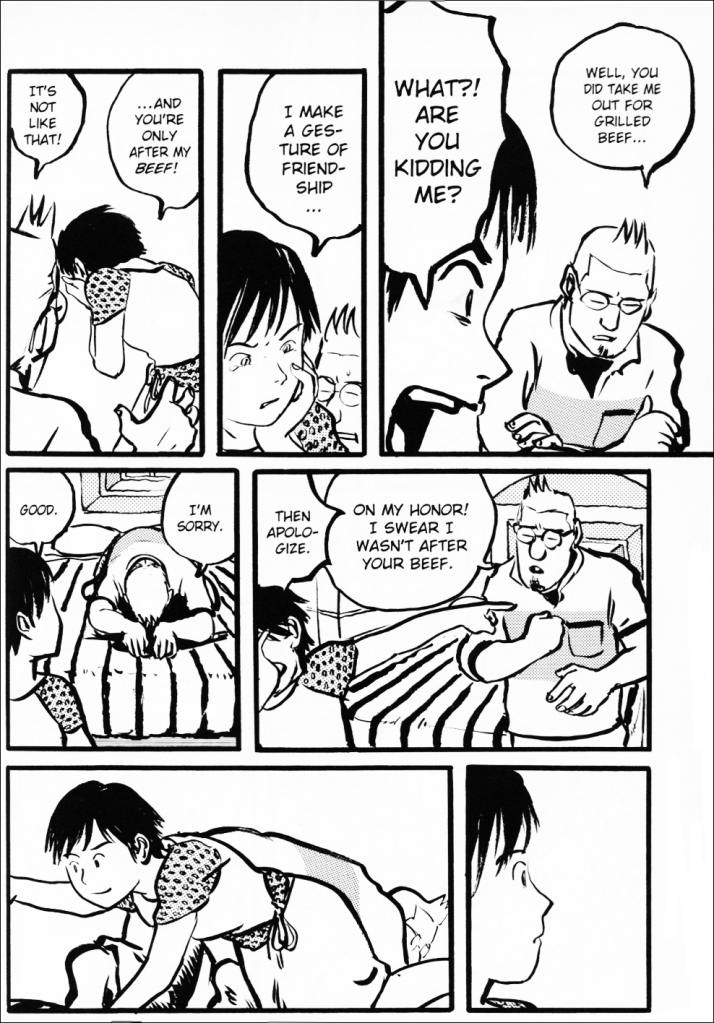
Nico Hayashi has two amazing abilities, one is immediately obvious and the other is a little more subtle. She has the ability to change her voice with tremendous range. This ability has led to her uncanny insight into how people think and consequently which lets her read people like a book. One day an old gentlemen notices Nico’s talents and hires her to be a troubleshooter for various odd assignments. During her first mission she cons the otaku Iichiro Sudo into helping her. She soon forms an odd friendship with “Robo” as she calls him and involves him in various other assignments. All the stories in Sexy Voice and Robo involve Nico getting involved with someone and their problems. Almost all the cases revolve around one or more self-involved people with selfish problems. Although she is being paid by the old man for most of her mission it is obvious that she loves solving mysteries and figuring out how people work.

The style of both its story artwork are captivating in Sexy Voice and Robo. Take the visuals which will hit you immediately, it has got a more raw and energetic feeling than much of the manga released in English. The uncontrolled line work, the less precise flow, and the boldness of the strokes and shadows really enhance the read. It’s a comic by all means but it has a fine art quality to it at points. And at other points it made me think about American indie comics. I don’t know how much they have influenced Kuroda, but it comes off as a great hybrid style. The story then takes all that energy from the art and adds humor and a charming bittersweetness to top it off. This story simply stated is about a few happenstances meetings which lead into a whirlwind of human stories that are all little off kilter but moving.
Continue reading

Ongoing Investigations: Case #074

Detective Conan Movie 3: The Last Wizard of the Century was quite memorable thanks to a mystery that swirls into a full-blown historical conspiracy. And the appearance of that charming phantom thief Kaito Kid! When the Kid delivers his latest riddle about where he will strike of course everyone is in a uproar but Conan senses something different about this heist as Kid signs the message “The Last Wizard of the Century.” Once they decipher the target as the a recently discovered Fabergé egg belonging to Nicholas II of Russia, Conan is even more perplexed as the piece upon examination contains no jewels (Kid’s item of choice). And that is just the tip of the iceberg as Kid leads them on a chase into a mountain of clues and mysteries that come one after the other. And of course there is a murder afoot as well. Plus Heiji is also in tow as the game begins. Ah, they crammed everyone in this movie but it just makes it more fun and spectacular. The way it keeps leading you to the next mysterious piece of the puzzle is engrossing. This was a great ride!

I have always been distinctly aware of the Detective Conan franchise but never really watched any episodes before this movie. This was a good test of how accessible the movies are to someone who did not watch the TV series. I found that with my general knowledge of Conan and the little intro I was able to follow the story. I might not have understood all the nuances but I was never left scratching my head about anything. What starts as a simple case of stopping the legendary thief Kaito Kid becomes a series of murders surrounding the late Russian royal family. That of course means that Grigori Rasputin is also involved because you just can’t have a story about the fall of the Russian royalty without him. By law. I have to say that if nothing else the movie peeked my interest in watching the rest of the franchise as it seemed very enjoyable and fun. I did not realize what a utter putz Kogoro Mouri is. Also the detective kids seemed sort of tacked on because that is how movies based on TV series work. I will say as I have in the past if you want to see some lovely high budget animation got to the family friendly shows. They get the wide audience that lets them spend money as they will and it shows when they put on a theatrical piece. It was a fun romp with all the murder, action, and mystery you expect from the Conan series.

Since I don’t like NISIOISN I was a bit worried about watching Katanagatari, but something compelled me to do so anyway and I’m very glad I did. When the episode hit the ending credits, I turned to Hisui and said “I LOVED IT!” This is mostly owed to the fact that the characters really grew on me and didn’t drive me nuts and weren’t utter jerkfaces which is pretty much why I stay away from this writer. I really enjoy the simple-nature of Shichika that is dual to Togame’s attempts to be devious and “strategic.” And all the humor that goes along with them is charming. The styling of the show and its storytelling is this really lovely mixture of modern and flat but evokes a very fairytale or storybook feeling. I saw this especially in their use of music, such as the moment when Shichika and Togame meet for the first time. And I was happy to see that the fight was pretty cool despite the obvious animation saving tricks used in the beginning. The only real flaw with this episode was a load of story exposition that was dumped, but it lays everything out for you, and since the episode is 50 minutes long it didn’t come off as unbalanced as it could have otherwise. Katanagatari is like a familiar story that you can’t wait to watch even though you’ve heard it before.

I was wary going into Katanagatari. I both like and dislike NISIOISN as an author. The problem is that he has a good sense of how to make interesting stories but a penchant for making characters that get right on my nerves. The story is the standard fetch quest by way of beating highly skilled opponents with gimmick weapons.  This hardly dooms a show. It just means that how well the show does is reliant of two factors: how good the characters are and how cool the gimmick weapons are. So far I have greatly enjoyed Katanagatari because we have yet to encounter a “NISIOISN” style annoying jerk character especially as the one of the main characters. Togame and Shichika Yasuri seem very likable and have an easy comical chemistry between them. I’m sure they could add a new character I will want to strangle but so far this has not been the case. I am intrigued by the way the series is being released. It is being released on episode a month and each episode will tentatively be an hour long and based on one of the books in the series. So far great animation with a cool style, amusing characters with nice comedic timing, and the promise of some cool fights is keeping me watching.

Continue reading

February’s Final Denouement: The mysterious use of screentone in OEL.

Because of a random comment that occurred while looking at pages from King of RPG’s, I found myself taking a closer look at the use of screentone in manga the past couple of weeks. Essentially the comment was that something about the way OEL uses screen tone feels different from manga which it is supposed to be derived from. But what exactly was the difference, well, that required closer inspection, thus I type before you now.
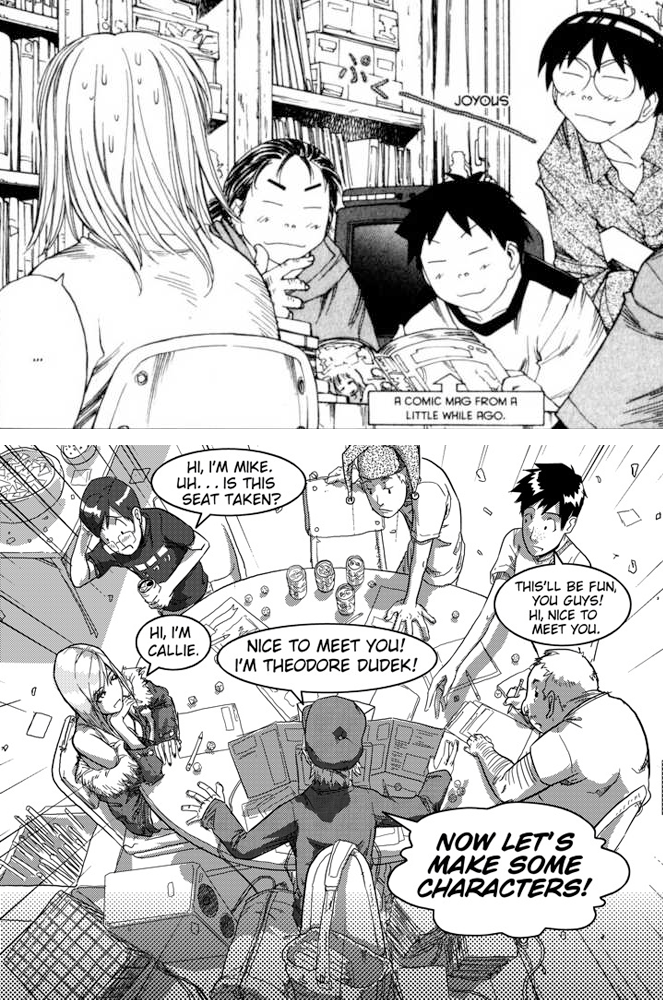
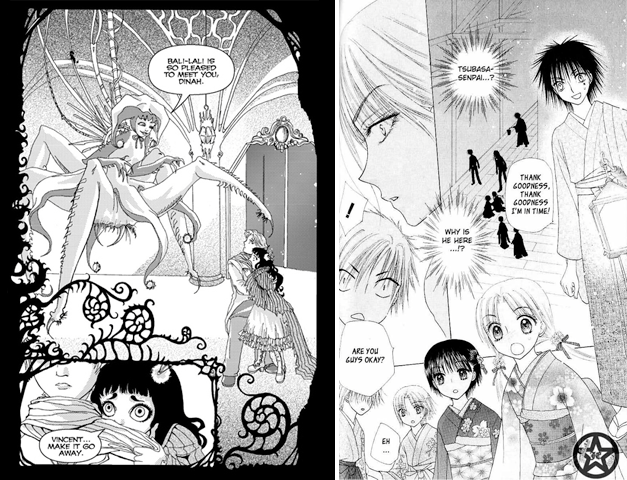
Screentone use in manga I came to feel, or realize, was lending texture, pattern, the idea of color, or providing emphasis or deemphasis as it may be, and even creating mood. The characters themselves were often devoid of tone, except maybe a pattern on their clothing or perhaps their hair, with little shading.

And shading is where I started to feel the difference. Screentone in manga is used more flatly, whereas in OEL there is depth emerging. Characters in the foreground were not being given pattern with screentone, but instead were being shaded extensively with it in OEL. When screentone was showing up in the background of manga, it was more for pushing back the image in order to let the foreground characters pop. It was also lending a mood or feeling to the events occurring on the page. Contrastly in OEL, backgrounds were becoming less abstract with more of an emphasis on perspective. OEL is attempting to create a more multidimensional space using screentone as the central tool.

Randomly, I feel that digital screentone is still working the kinks out. This method is quite popular in OEL. I won’t say I can always tell when it is being used, but it can be easier to pinpoint. There is such a crispness to the lines when working completely on the computer that it becomes more obviously manufactured. There is a disconnect from the slight fuzziness that happens when scanning in a work of art.

Since all artists have their own styles and quirks there are always going to be exceptions and incidents here and there. But I think I have come to grasp some of the basic general uses of screentone in manga and OEL and the differences that can be seen. While I can’t say what has caused OEL to move in this direction, perhaps it is just a western emphasis on a more realistic aesthetic. The more I looked, the more I came to find OEL to have this emerging stylization even if only by accident.