Ongoing Investigations: Case #169

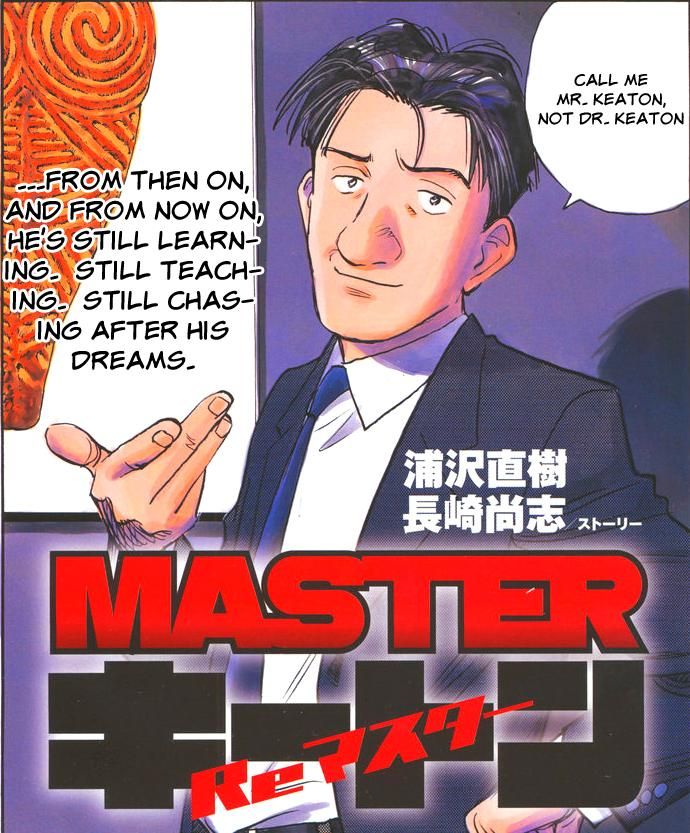
In a most unexpected turn of events the Master Keaton manga returns to the pages of Big Comic Original in the form of Master Keaton Remaster. I guess at least some of the rights issues around the original manga have been cleared up because I know for awhile the original manga series was quite expensive due to it being out of print. But now Taichi Hiraga-Keaton is back! He is still an amusing mixture of a loveable loser and an amazingly competent superman all in one package.  The series starts not long after the end of the original manga. Keaton is notably more entrenched in his academic career after his recent archeological discovery. But just when he thought he was out of the insurance game for good it draws him back in for what he is told will be one last job.

Of course this being Master Keaton we know that will not be the case. Soon he is investigating ruins, redeeming the honor of a man in a coma, and fighting slaver traders. All for one insurance case. It has all the mature elements that you expect from this manga. The story has a well researched history, a steamy underworld, and characters that show their complexity even if we only know them for a chapter or two. There is rape and sex slave traffic but there is nothing graphic or salacious. It just happens to be a story with the disgusting parts of the sex trade as a piece of it. All the bite of an adult story with none of the guilt.

One of the most interesting parts of any Master Keaton story is the fact that Taichi usually comes is for the climax of a story. He is presented with a case, does a good deal of research to find out what is going on, arrives at the critical moment during the ongoing story to help someone out, and then leaves before the falling action is over. This could be amazingly frustrating if done poorly but Naoki Urasawa does this in a way that merely makes you feel like the stories are and organic part of the world. Taichi does his part, and then leaves, and that is all we see. But we get enough of the story from Taichi’s perspective that it always feels satisfying.

I’m am really glad to see the manga running again. Master Keaton is some of the best bite sized seinen you can find. Hopefully they will work in his daughter soon as she is always a refreshing character. Maybe this renaissance of the series will help get both parts licensed for English. That would be masterful.


I watched the first two episodes of Motorcity, a new Disney DX animated series. It showed a lot of promise and sported some cool animation.

The story revolves around a futuristic Detroit with two levels to the city; the old, underground, and free area known as Motocity; and the modern, controlled, upper Deluxe.

Mike leads a group of car fanatic rebels known as the Burners who are trying to bring down the leader of Deluxe. Mike is pretty interesting as he isn’t a kid, but a 17-year-old who was once being groomed by Deluxe’s leader. Now having defected, he is putting all his skills and some sweet modded cars to use.

Also of interest is Jules a resident of Deluxe who is actually helping them secretly. And she just happens to be the daughter of Deluxe’s dictator. But even the rest of the Burners and Mike don’t know that about her.

Both episodes revolved around some sort of threat being sent down to Motorcity. There was lots of cool machinery and robots and whathaveyou to keep things interesting.

These were great episodes and I can’t wait to continue. Definitely something I’m going to attempt to keep up with. The episodes are streaming on Disney DX’s website so far.

Continue reading

Ongoing Investigations: Case #168

I picked up The Story of Saiunkoku vols. 1-7 recently and my goodness has this only renewed my passion for the series. I fell in love with the anime a few years ago, so far this manga has followed it quite closely (both being based on a novel series which I have no way of reading, I don’t know if it follows the books closely as well).

Saiunkoku, put simply, is about a kingdom and a romance, but the series is far from simple.

In these volumes, we meet a large cast of nobles and get caught up in assassination schemes, courtly politics, syndicate wars, and various governmental situations. Shurei is a smart, hard-working, but poor, noble who is brought to court in the hopes of helping the new emperor. She not only forms a close relationship with Ryuki the emperor, but also many others in his circle. Shurei not only helps guide the emperor but begins gaining friends and influence in the politics of this large kingdom.

And that is what is so special about Saiunkoku; the political and societal struggles of Shurei and women in this ancient land. A good portion of the series after the first two volumes is Shurei dreaming and applying herself to become a civil servant which no woman has been allowed to do.

While the series also wears the hat of reverse harem, to its credit all the men are fascinating characters with their own places in the court and politics. And by and large they are not in love with our heroine. The story is pretty clear this is about Shurei and Ryuki. But on that note, it is amazing how little time these two actually get to spend together because of their stations and duties.

The story has a clipped pace never lingering too long on any one thing. At times I found myself really yearning for more time for Shurei and Ryuki to no avail. There are moments with a bit too heavy exposition but they seem to lessen as the volumes go on. All in all, it is a great world with a great cast that you want to know more about.

I will say that they wrapped up the first season of Young Justice quite nicely. I did feel that one or two of the slow building plots were quickly resolved in the last 2 episodes but that is more of a stylistic issue than a major complaint. Over all they did a good job of having everyone one in the main cast having some noticeable character progress while at the same time tying all the episodes together into one cohesive plot. I do find it a bit odd that all the new animated DC series seem to be utterly in love with Vandal Savage. While he is decently old character I myself had never heard of him before recently. But he makes for a good foil to teams as opposed to some villains who are better off as either pawns of a bigger villains or as the nemesis for solo heroes. I also have to applaud them for adding more women to the team with the addition of Zatana and Rocket. At the same time while Zatana gets a decent amount of screen time for a late addition Rocket sort of gets thrown in at the last second. So I thought, “Well she can get more screen time and character development when they come back for season 2.”

Then very surprisingly the next week went straight into season 2. And people HATED it. While I can’t say I was in any way as angry as other people I do feel their pain. The season starts after a 5 year time skip. Most of the Young Justice team is new, half the old team is nowhere to be seen, and most of the team that we see is remarkably different with no explanation.  I recognized all the new team additions but is mostly because I have a solid albeit firmly intermediate comics education. Well I recognized everyone except for Lagoon Boy. But all those underwater guys who are not Aquaman are super-duper high level nerd territory anyway. I am sure the average viewer would at least need some explanation for who the Blue Beetle is. The problem is unlike The Avengers: Earth’s Mightiest Heroes they don’t do the greatest job of introducing people without exposition.

I get that they are going for the risky payoffs of the in medias res plot revelations but the execution is somewhat off.They did such a good job of building up the first team. If they just skipped ahead but kept the team the same it probably would not have felt so jarring. Both changes combined really throw off the flow of the story. I will continue to watch but I feel that the choice was a major misstep and apparently most of the audience agrees. Hopefully they payoff for the reveals of what happened during the time skip will make this all worth it.

Continue reading

Ongoing Investigations: Case #167

Sumo is a gimmick comic. That might seem like an insult but when a gimmick comic concept mixes with a solid story it can become something far greater. When the story is weak in a gimmick comic than you often just wind up rolling your eyes as you call out the novelty piece of the story. But with Sumo its storytelling twist adds to its great story to give you the feeling you are reading something innovative.

The story in itself is simple. A washed out NFL hopeful moves to Japan to become a Sumo wrestler after a devastating breakup. While he has an amazing amount of promise he has been doing rather mediocre and his next match is a pivotal point in his career. The story jumps back and forth in time with each period in time being its own color. This lets the reader know when each piece of the story takes place without text balloons or exposition but at the same time also lets the color of the time period reenforce the mood of the story at that point. The blue really helps reinforce the melancholy feel of Scott’s time in America, the green shows Scott’s awkward transition to life in Japan as he gets to know his manager’s daughter, while the orange helps express the spirit invested in Scott’s critical match.

If the story was not there, this would merely read like a slight curiosity. But instead this instead demands your attention and begs to be used as an example for anyone wanting to explore the use of color in comics.

Sumo is by Thien Pham who worked with Gene Luen Yang on Level Up which we liked a lot.

The story of Scott is a fairly simple one told in alternating time frames but each piece meets up at the end with poetic force. Though I was a bit surprised we don’t know the full outcome, but we do know that Scott’s life and his understanding of what he wants has changed.

Thien’s simple artwork is bold and iconic using strong lines to express a variety of emotion. One minor quibble I had with the art was during the Sumo matches, it was sometimes hard to tell who was who. The use of color as Hisui mentioned is very important in the book with oranges for Scott’s life in the present, bright with possibility; blues for his past in America, a time of coming-of-age and letting go; and greens for his (more recent) past in Japan, new life and growth taking over. All of this makes the sparse amount of dialog more powerful allowing you to let the emotions wash over you.

Sumo is a quiet story that has immense power.

There is a preview available, too.

Continue reading