
#0094
People never seem to pay attention to me so I take that as a sign that I am average looking.
 This part of the survey is really about how otaku see themselves, not how the outside world sees them. Though of course our own opinions, whether we like it or not, are largely based on what we have experienced in the world around us. Here, more than ever, honesty is about taking away any facade you may have in the presence of others and telling it how you really see it. And in this way the results may not be the “truth” but they are a way to gauge confidence, self-esteem, and to understand how we measure up to our fellow otaku.
 Over the years I have learned one simple fact: Everyone views events through their own unique filter. You can have 100 different people experience the same event and get 100 different interpretations. The simplest example is asking someone if a glass is half-empty or half-full. But each person paints their view of the world from their own individual paint set. Some colors come from birth and upbringing and some colors come from experiences in life. But the pictures each person creates have a style that come from our interpenetration of events as well. This goes for internal perception as well as external. The next few Otaku Diary posts will look at the self portraits that a participants drew of themselves. How does the otaku surveyed view themselves? Do otaku see themselves as half empty or half full?
#0069
I know I have the potential to fit my own views, but unfortunately I got dealt a hand that hasn’t made my appearance easy.
I don’t think it would surprise anyone to hear that many otaku don’t have much confidence when it comes to themselves, in this case their outward appearance. This is a long discussed issue for many adolescents but it can come down harder on the geek/nerd/dork variety leading into an adulthood plagued by putting no stock in their appearance. Looks can be a major factor in bullying or isolation as well, two things that in our previous survey showed to be very prevalent in the group. This can have varying results between being able to value others beyond them not being (or being) conventionally good looking or becoming bitter to the point of rejecting anything that has to do with outward looks. However, those resulting characteristics weren’t apparent. But looking at the overall reaction to this question, I have to say I’m rather impressed with the positive results. It seems quite natural and possibly the reaction you would get should you ask 40 random people on the street the same thing.
#0045
I wouldn’t, but I must be with all the girls that I attract. Somedays I see it, others I don’t.
#0036
No, something is always out of place. Either my skin, or I have put on some weight and have a disproportional gut, or my hair looks awful-even if it all was fine, I’ m not really a looker.
Simply put the pretty people of the world as less inclined to get into geeky hobbies. That does not mean that everyone who is a geek is average looking or unattractive. Especially after more women have entered into anime and manga fandom, the overall attractiveness of the average con goer and anime club member has slightly increased. But our results seem to indicate overall otakudom is filled with those people who are not so good-looking that everyone gathers around them. But they also indicate it is not just made up of the dregs. We see a decent bell curve of attractiveness in our participants. This more honest self-evaluation of appearance is what I expected. I think people are better able to judge how attractive they are because it is easy to gauge other people’s reactions to them. Individual prejudices will cause some people to be overly harsh on themselves and others overly generous but overall it is easier to see if people think your are appealing than if they think you are smart.

#0030
In short, yes. I’ve seen such insane amounts of stupidity both in person and via news sources and such that the average person is clearly not very intelligent.
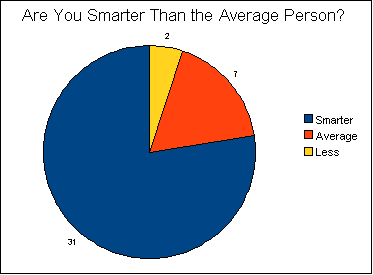
On the other hand, if there is one thing that a majority of otaku seem to agree on, it’s that they have a higher intelligence level than the everyday person. This isn’t surprising, but setting the results of perceived intelligence against perceived attractiveness shows where and what the confidence levels are. Being smart sets them apart, this explains why other people don’t understand them, and this can be how they take pride. For a lot of people, being smart was who they are, it came somewhat naturally to them from an early age. In an extreme case it could be even used as something to hold over people, to exert strength in lieu of say popularity or charisma. It’s almost as if aren’t good-looking you have to be smart, or atleast you have to think you are. Being a fan of anime and manga may not make you automatically smarter, obviously we have all seen conversations that would blow that theory out of the water, however geeky hobbies to tend lead its participants to theorize, debate, and converse on a different level.
#0044
I consider myself worlds beyond the average person.
#0009
Work in any job that interacts with the general public on a daily basis and you’ll soon discover that the average human being is pretty damn dumb.
#0039
Yes, and I have the IQ scores to prove it.
#0034
I’d usually prefer not to come out and say it directly like that, but at least if you’re talking about “book smarts” the answer would probably have to be yes.
Where as the we had a nice bell curve with attractiveness we had no such phenomenon with intelligence. People were much more willing to brag how much smarter they were than the average person. I think that comes from two major factors. The first being that like many geeky hobbies, it draws people who tend to be smarter. Clearly not everyone who is intelligent is drawn to doing geeky things and not everyone doing geeky things will be smart. But I want to believe that anime attracts a more intelligent crowd than more mass media materials. The other reason for the higher numbers is your evaluation of your intelligence is so much more internal therefore easier to paint yourself as smart. Unless your self-esteem is broken or experience has shown you be to utterly outclassed by your peers, you tend to think of yourself as intelligent because intelligence is all in your head. It is much easier to assume everyone is wrong about you not be so smart than it is to assume that everyone is wrong about you actually being hot.
One word questions are difficult but also telling. What is the word that people would walk away with after meeting you for the first time? Some people cheated and gave more than one word, so for them I had to just pick from the list of options. Only one person flat out refused to answer it. We had a couple of overlaps, but for the most part everyone came up with something all their own. While I think this type of question is very difficult, it is also very telling. Some said things along the lines of “I hope it would be . . .” or others answered with just the word, as if they knew it without any doubt.
Creative, Arrogant, Grumpy, Insane, Otaku, Strange, Eccentric, Intellectual, Enigma, Anxious, Interesting, Unique, Pragmatic, Funny, Energetic, Nice, There, Unpredictable, Villain, Lazy, Hidden, Awesome, Asshole, Sincere, Thoughtful, Roadrunner, Social, Unforgettable, Excited, Shy, Even-keel, Quiet, Opinionated, Verbose, Passionate, Nice, Inward, Eccentric, Weird
I was impressed that we had few overlaps in the words. The question seems to ask what other people think of you. But in all actuality it mostly shows what you think your most prominent feature is. Everything from extremely positive to extremely negative. There was a tendency to go for the more unusual, off kilter, or inwards words but I think that is the tenancy of most nerds. Please note that even words that seem similar have very important distinctions. “Shy,” “quiet,” and “there” might all seem the same but they imply very different things. In my opinion shy implies a positive connotation. Someone who has a lot to offer but is not able to easily show that to others. Quiet is much more neutral. It implies nothing other than the person is not quick to open up to others. The word there on the other hand is quite negative. It implies people have gone out of their way not to connect to the person and perhaps have reason to. It is amazing to me how much of a person you can get from a single word. Also people tend to be slightly more unguarded with such questions.
#0099
I don’t have much of a presence or personality, so I’m not that memorable. The best one could probably say years later was that I was just there.
An interesting question that arises in my mind is whether or not looks has anything to do with people becoming engrossed in their chosen hobbies. Does one influence the other? Obviously not everyone who is attractive avoids geeky hobbies like the plague and likewise not every intelligent person has participated in a game of “Who would win in a fight?” I also find it telling that almost everyone found themselves to be smarter than the average person, I wonder how that would stack up if we changed to the question to “Are you smarter than the average anime fan?” In any case, people seem to take much pride and perhaps just a little bit of devilish joy in saying they are brighter than most bulbs.
If it is a a school, a job, a hobby, or anything else there is a certain type of person that is more likely to be drawn to it. How much attractiveness has to do with this is a good question. Another question that pops into my head due to our results is if otakudom and the world in general is mostly made of average looking people who just think they are much smarter than they actually are? I mean I think we have all had conversations with members of anime community that have proven 75% of anime fandom is not made of the world’s greatest think tanks. On the other hand, I have had conversations with people in fandom that have proven to me that some very intelligent people are members of the community who can dissect trends, analyze information, and create works of amazing genius. This leads me to think that while there is some delusion of the overall intelligence of anime fans it is not without a grain of truth.


 I went in to
 Reverse Thieves