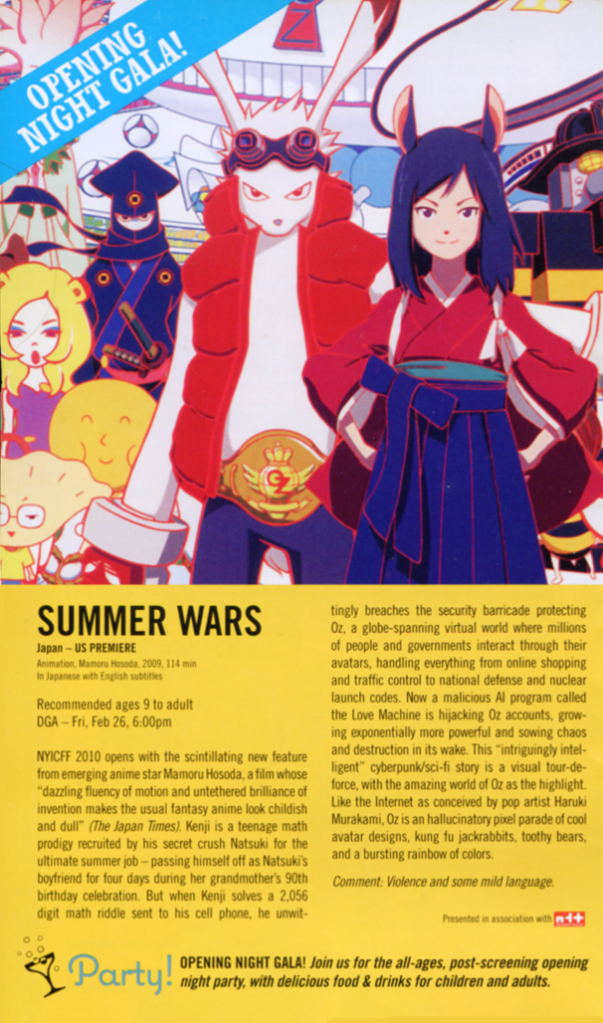
NYICFF 2010: Summer Wars w/ Mamoru Hosoda, Guest starring Rabbit Terry Bogard.

When I heard that Hosoda’s plans for his next film were in the works, I was truly excited. Afterall, The Girl Who Leapt Through Time instantly became a favorite or mine, and not one that I will soon forget. So basically after hearing “He is making something, and it is called Summer Wars,” I promptly tuned out any information thereafter. Something made me want to jump in blindly, to be completely caught unaware by this next film. And truly I went into the theater with no knowledge of the plot and having only seen the poster for the film. Going in really on faith alone that it would be amazing seemed to really stimulate my imagination so you dear reader may want to turn back now and enjoy that same feeling. Though there aren’t any spoilers here, even the analysis of Summer Wars characters and themes seems like I’m telling you too much if you haven’t already experienced it.

A question I often hear is “Who is going to be the next Hayao Miyazaki, Satoshi Kon, or Mamoru Oshii? Who is going to be the next reliable anime director that people can expect quality films from?” The worry is that as the great anime directors of today retire there will be no one to take their place. I will say with full confidence that Mamoru Hosoda is a name everyone should be watching as a worthy successor to the great anime directors of the past and present. His outstanding work on the 6th One Piece film and The Girl Who Leapt Through Time had caught my eye in the past. And Summer Wars has solidified him as a director I shall go out of my way to research and keep an eye out for what he is doing next.

Continue reading

The Rough Guide to Anime, Hoofing it in the Anime Outback.

As someone who writes for a blog that updates at least twice a week, it is extremely obvious that I have a passion about anime and manga. This lends itself to me taking an interest in books that examines anime as well. So when Narutaki was able to get the Rough Guide to Anime for an incredibly low price I was only too eager to review it. The Rough Guide series started as a series of travel guides for backpackers but in 1994 branched out into books that give overviews of various topics. In a way they a pretty much like For Dummies books but with a more rugged title. The book attempts to introduce the reader to what anime is and how unique and versatile it can be.

When I hear you say that, it makes me think about the people who are buying this book. How many of them are people who have a casual interest in anime and want to understand it better and how many are just bloggers, etc. who grabbed it to see if they find it sufficient. And of course every guide of every thing ever will have people divided on just how good it is and if they writer knows enough to call themselves an authority. But as luck would have it, Simon Richmond isn’t an entrenched otaku himself and so it’s almost a perfect look at what someone with a casual understanding of anime finds significant and interest grabbing.

We start with a brief history of anime going decade by decade to show how the medium started and then how it has changed over the years. The guide then runs down a list of 50 anime that everyone should see. The list is a mixture of TV series, OAVs, and movies with the main focus of being exceptional anime from through out the history of anime. The book then looks at the people who make anime with sections on studios, directors, voice actors, and musicians. It then segues into the various genres within anime with a few notable examples from each genre. The next section is how anime has mixed with other mediums such a live action dramas based on anime, video games crossovers, foreign co-productions, and various parts of anime fandom. The series finishes up with a glossary and a rather large section of links so you can learn more.

What is most important in a guide like this is accessibility, and I think Simon nails that. The breakdown of sections as well as the language therein are casual and without a feeling of bias or superiority. I found the myriad of sections of proper length and depth free for the most part of tangents but nice side notes and boxes for more information on some terminology or a specific incident or show. There is obviously a great deal of time dedicated to Tezuka, as is warranted, but I do feel others needed more focus overall. This is helped somewhat in the call-outs to important names but some times to confusion. For example, Go Nagai is certainly a name to know but why is he in the directors section? I think it would have been best to just have an overall section of influential people. This would have also made the seiyuu and music sections look less neglected.

Continue reading

Sexy Voice and Robo, The Girl and the Otaku from U.N.C.L.E.

I actually watched the live action series of Sexy Voice and Robo, and enjoyed it immensely, thanks to it staring Matsuyama Kenichi (of L fame). I’m not sure exactly at what point I found out it was based on a manga, it must have been from Hisui. In any case, this Manga Moveable Feast deal seemed like a good as time as any finally get around to reading this work involving an amateur sleuth, a role that I have an immense fondness for, and a robot otaku.

I picked up the Sexy Voice and Robo manga a few years ago after reading several positive reviews and finding its independent comic vibe quite intriguing (plus the comic store had it 40% off). I liked it so much I threw it on my 2008 year in review but until now it went without a full discussion. When The Manga Curmudgeon proposed this project we both decided to throw in our two cents on a great franchise we had not given our full attention to on the blog.

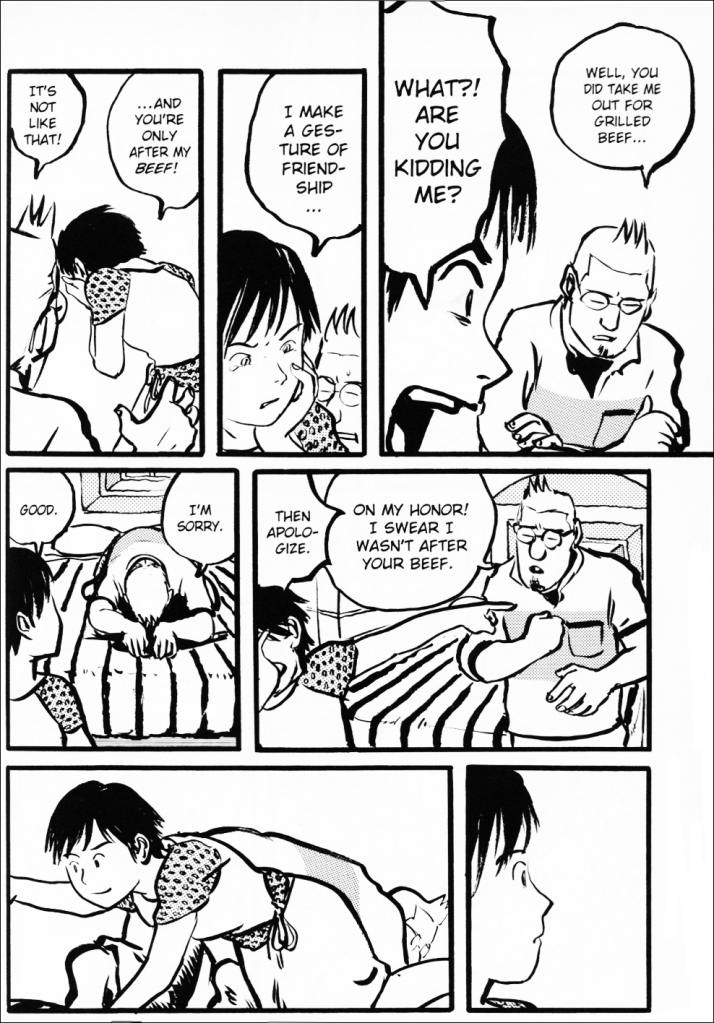
Nico Hayashi has two amazing abilities, one is immediately obvious and the other is a little more subtle. She has the ability to change her voice with tremendous range. This ability has led to her uncanny insight into how people think and consequently which lets her read people like a book. One day an old gentlemen notices Nico’s talents and hires her to be a troubleshooter for various odd assignments. During her first mission she cons the otaku Iichiro Sudo into helping her. She soon forms an odd friendship with “Robo” as she calls him and involves him in various other assignments. All the stories in Sexy Voice and Robo involve Nico getting involved with someone and their problems. Almost all the cases revolve around one or more self-involved people with selfish problems. Although she is being paid by the old man for most of her mission it is obvious that she loves solving mysteries and figuring out how people work.

The style of both its story artwork are captivating in Sexy Voice and Robo. Take the visuals which will hit you immediately, it has got a more raw and energetic feeling than much of the manga released in English. The uncontrolled line work, the less precise flow, and the boldness of the strokes and shadows really enhance the read. It’s a comic by all means but it has a fine art quality to it at points. And at other points it made me think about American indie comics. I don’t know how much they have influenced Kuroda, but it comes off as a great hybrid style. The story then takes all that energy from the art and adds humor and a charming bittersweetness to top it off. This story simply stated is about a few happenstances meetings which lead into a whirlwind of human stories that are all little off kilter but moving.

Continue reading