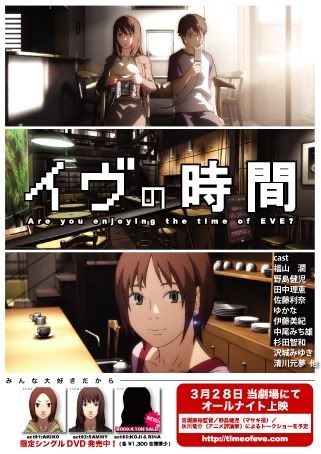
Time of Eve, All About Eve

Narutaki and I found this series when we were doing our overview of Crunchyroll. We decided to check it out on a whim and were impressed how well it was done for something that was otherwise completely off our radar. It is fascinating series for a number of reasons. It is a sci-fi series in a time when sci-fi series seem so rare. It is also an ONA not based on an established property. I am hardly the most informed anime fan but I usually have a decent idea of what is out there. So when any modern title comes out that I do know about it is always intriguing.

I stumbled across Time of Eve and I don’t even recall how beyond the fact that it was on Crunchyroll while I was testing the site out. Though I am always interested in short series to check out in between other longer shows. Time of Eve fit into this doubly so because the episodes came out rather infrequently and minus the final episode run only 15 minutes long. However, don’t let that fool you into thinking this show doesn’t do anything, it uses its minutes very wisely.

  1. A robot may not injure a human being or, through inaction, allow a human being to come to harm.
  2. A robot must obey any orders given to it by human beings, except where such orders would conflict with the First Law.
  3. A robot must protect its own existence as long as such protection does not conflict with the First or Second Law.

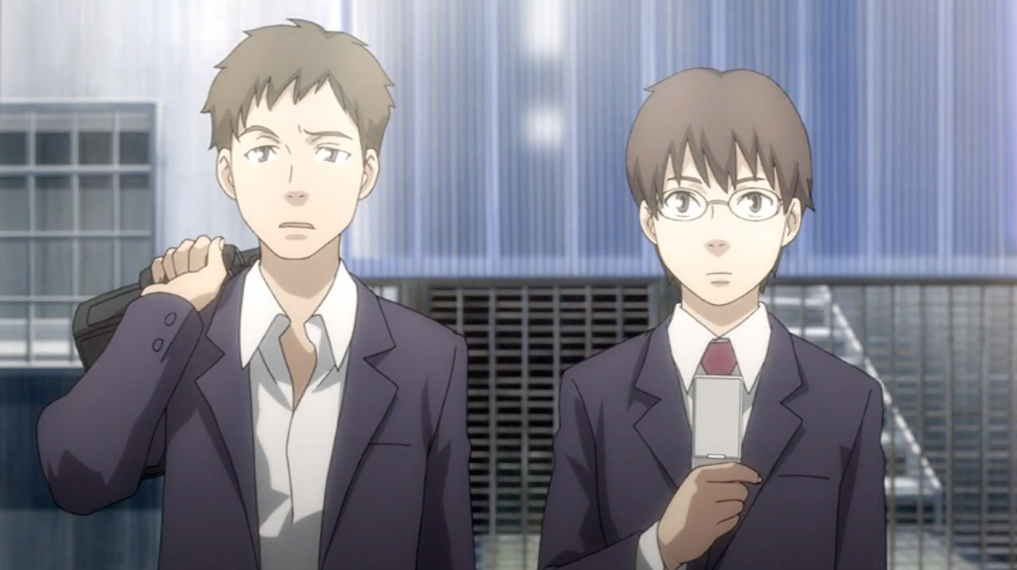
In a deliberately unspecified time in the near future robotics has advanced to the point where androids are nearly indistinguishable from humans. They are so hard to tell apart that androids have halos over their heads to identify them. One day Rikuo notices that the android his family owns, Sammy, keeps disappearing from time to time. After some investigation he discovers that she has been going to a cafe named the Time of Eve. In this cafe no halos can been seen in hopes of promoting everyone treating each other as equals no matter who they are. Rikuo and his friend Masaki soon start coming to the cafe and slowly learn more about complexities of the dynamics between humans and robots.
Continue reading

Manga of the Month: November

Honey and Clover by Chika Umino

If Honey and Clover was always sepia toned it would never seem horrifically out of place. Honey and Clover is a joyful if melancholy tinged looked back on college life. It looks at the lives of 5 students at an art college in Tokyo. The main theme is trying to figure out where you are going. Everyone is trying to discover where exactly they are headed with their lives before they enter the “real” world. Of course being college students there are also messy and mature relationships do deal with along the way. Everyone’s story is a mixture of joy and sadness like the bitterness and sweetness of a honey and clover sandwich.

Yuta Takemoto is effectively the main character of the story. He is a directionless art student who falls in love with with Hagumi Hanamoto, the niece of one of his professors. His friend and super senior Shinobu Morita falls in love with her at the same time. But Hagu is a shy and extremely sheltered young genius and finds it hard to interact with others. Takumi Mayama is a also their friend who is poised on graduating. Their mutual friend Ayumi Yamada is in love with Takumi but he only has eyes for Rika Harada a young widow whose soul is a broken as her body. We see all of them go through school and try desperately try to find where they need to be after college.

I think one of the biggest appeals for Honey and Clover is it’s more mature setting. We get so many high school anime but it is a nice change of pace to see a solid dramedy set with some older protagonists. I think these older characters who eventually have to deal with jobs and more mature relationships is refreshing while still having the vibrancy of the college experience. All of the characters are very relatable and amusing. You will feel triumph at their successes and heartbreak with their losses. The comedy is extremely well done and prevents the series from being gray colored slice of life quagmire. Shinbou could get his own spin off series and all the women and most of the men reading would probably buy two copies each. Honey and Clover is a amazing series that captures the highlights and low points of being young enough to have the world before you but old enough to know how scary that is.

Palette of 12 Secret Colors by Nari Kusakawa

I have absolutely fallen in love with the work manga-ka Nari Kusakawa does. My most recent passion is for Palette of 12 Secret Colors which takes place on island that houses the most beautiful birds in the world. Cello a “palette” in training (and many others) use the birds’ bright colors to change ordinary things, like cloth and rocks, into precious treasures that are sought the world over. But Cello’s magic doesn’t work like anyone else and usually manifests itself best when she is in danger but her unique abilities get her into some interesting situations. Cello is positive, funny, passionate, and easy to love. As the story goes on we see Cello struggle with how she wants to use her palette skills after her training is complete. However, most things take a back seat to the budding romance between her and the school nurse. She often turns to Dr. Guell, he is blunt but funny and caring, so much so you can’t help but root for these two to come together. Things between these two move along at a brisk but believable pace through a series of mostly humorous incidents about town involving the birds of the island, random students, thieves, and old friends. While the majority of time is spent on Cello or Dr. Guell, there is a colorful side cast that liven things up constantly from Cello’s rambunctious dad who forms an amusing kinship with Dr. Guell to Yoyo and Olga’s scheming to keep their masters apart that ensures funny happenings both in the background and foreground of this manga. Palette of 12 Secret Colors is a charming combination of fantasy, romance, and a huge helping of comedy. And with a mere 6 books to collect, it shouldn’t be missed!

Mechademia #2, Return of the Anime Literati!

We continue our scholarly pursuits by reading book two of the Mechademia series entitled Networks of Desire. I am personally glad to see that the University of Minnesota Press is still able to put of these books with a 4th coming soon. It’s gratifying to see a healthy forum for academic anime publications. This volume was printed a year after the first Mechademia so we are examining not only the essays within book but what changes and improvements have been made since their freshman effort.

We are always trying to broaden our horizons here on Reverse Thieves. One of the quickest ways is to really sit down and read a bunch of essays that you only half understand! Okay, so Mechademia isn’t that impossible to understand, but it certainly makes you take a closer examination of series or parts of fandom that you might not have before. There is a wealth of knowledge in this new volume!

The Shojo section is papers based around female-targeted manga and female otaku related issues. None of the essays had too high a level of prerequisite amount of knowledge needed to understand any of the articles. My favorite essay in the section was the article of the Rose of Versailles and it’s impact on shojo manga. As a huge fan of Rose of Versailles I enjoyed learning of it’s historical impact, back story, and behinds the scenes information on the manga. There is also a fascinating piece in the section about Mori Mari one of the founders of yaoi. The article looks at how yaoi works relate to both it’s primary female audience and the gay community in Japan. I am always interested in the gay community’s reaction to yaoi in any country. There was a solid article on Ranma 1/2 fan-fiction but I felt it was out of place in the section. While I admit the common perception is that most fan-fiction authors are girls this is hardly a hard and fast rule. Still the article was a interesting look at how fan-fiction has grown out of and changed anime fandom and fandom in general.

I was happy to see a paper about the influence of Rose of Versailles for multiple reasons beyond my fervent love for the series. The essay balances what was new and impactful about the story while weaving in the historical aspects of the famous manga. I learned a bit myself and the essay gives access for people to learn and understand a genre that, while not invented by her, was certainly taken by the reins and changed significantly by Riyoko Ikeda. The Doll Beauties essay was not about anime or manga, heck it wasn’t even about cosplay of characters from anime or manga, it was about the gothic lolita trends making it seem out of place while being well thought out. And while I thought the Mori Mari essay was a smart analysis, it was really more about the author and her relation to her father rather than being tied to yaoi’s rise and popularity. I’ll agree that this area of of the anthology is the most accessible, it’s all uphill from here.

Continue reading