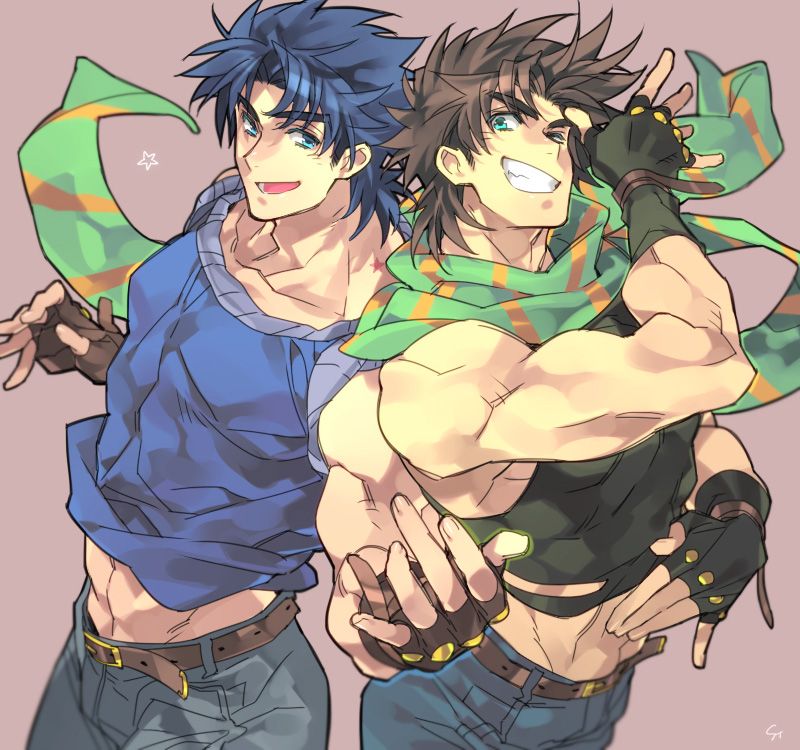
 After hearing much about it, I finally got around to watching JoJo’s Bizarre Adventure, specifically the 2013 series which covers the first two story arcs of the manga. It was quite a bizarre adventure. It reminded me a bit of Grappler Baki both due to the art style and in the style of action. The art features anatomically impossible muscle men often in beautiful poses, making kissy lips, and high fashion clothing. The crazy poses featured was mainly the only thing I knew about JoJo before going in, that and that there were some crazy mystical martial arts (again like Baki).
What I was not aware of is that the story of JoJo actually spans multiple generations, each arc featuring a different JoJo and taking place in different eras. The first arc features Johnathan Joestar and takes place in the late 1800s in England. The antagonist is JoJo’s adopted brother, Dio Brando. The second arc features Johnathan’s grandson, Joseph Joestar and the big bads are the “Pillar Men,” ancient super powered beings who created the stone masks featured in the first arc.
The action is often over the top and melodramatic, but always engaging. Much like in Grappler Baki, a fair amount of time is spent on explaining exactly what/how the characters do these crazy things. The writers are always thinking up some really creative and crazy things for the characters to do during their battles. This is what really keeps JoJo so interesting and entertaining to watch, because it’s just one ridiculously awesome thing after another. Air Master is really the only other show I can think of that matches JoJo in the level of hilariously awesome fighting techniques.
There are the typical training episodes, after being defeated by one of the big bads, then the showdown at the end. There are a myriad of characters as well, and often times a previous enemy will come back as an ally to JoJo but they’re typically no match for the big bads and at best can only help with dispatching henchmen.
Like many shonen protagonists, the various JoJos tend to be naturally gifted in the use of Hamon (basically the series’ form of chi) but lack proper training and rely mostly on raw power/force of will over technique. That carries them for awhile, but then they are forced to train with a Hamon master to refine their abilities. In the case of Johnathan Joestar his master was Will A. Zeppeli, for Joseph it was Zeppeli’s grandson Caesar and the mysterious Hamon master Lisa Lisa.
Respect for one’s enemy also seems to play a big role in the JoJo series, as the heroes and villains alike seemingly show moments of respect for one another. Of course, that’s usually after one of them has died, but still it’s a seemingly central theme.
The opening and closing themes are both fantastic. I especially love the use of Yes’ “Roundabout” as the ending theme, it’s just such a groovy kick ass tune and the classical acoustic guitar lead in works perfectly for the usually high tension cliff hangers in each episode. Follow that up with the funky bass line and punchy drums and it gets you so pumped to watch the next episode!
I tend to enjoy series with all the above qualities mentioned, and JoJo’s Bizarre adventure I’m glad to say was no exception, I thoroughly enjoyed it from beginning to end and am now looking forward seeing the third arc.
– Lothos

 Kate and I were just talking about the fact that Crunchyroll manga site is probably the greatest boon for the Manga of the Month that has ever existed. It has a wide selection of lesser known manga that you can easily recommended with minimal financial cost while talking about titles that are getting legitimate release. Theoretically you can also do that with Weekly Shonen Jump but Jump titles are almost universally (with a few exceptions) the series that need the least amount of hype. Plus with titles like Yamada-kun and the Seven Witches (which you should be reading) there is a lot to recommend. So I should start with Soredemo Machi wa Mawatteiru.


 Reverse Thieves