
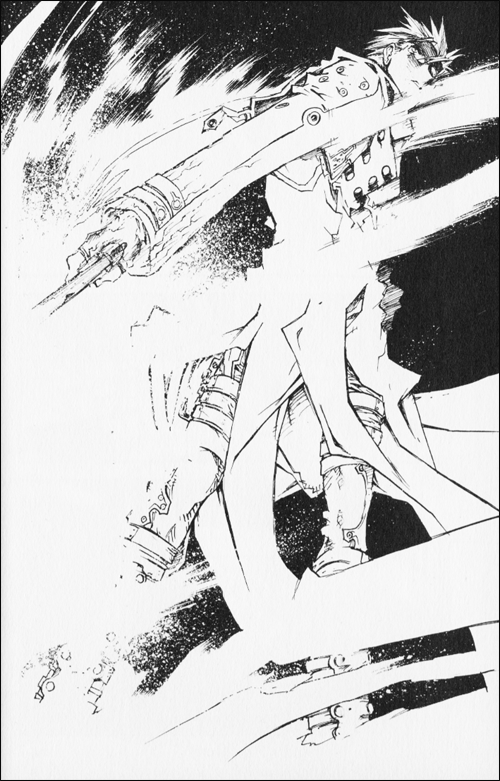
 We have been meaning to review Trigun for some time but now the stars have aligned in a way to make this extremely relevant. Funimation has recently license rescued Trigun and is putting it out on Blu-Ray and DVD. Madhouse released a Trigun movie on April 4th and Yasuhiro Nightow is writing a new chapter of the manga in celebration. Since Trigun first appeared on Adult Swim it has a solid fan following in the U.S. despite not being that popular back in Japan. We will be looking at what made the Trigun so enticing to English speaking fans and how is the manga different from the anime that was such a hit in the US.
 I remember Trigun fondly, the DVD was given to me at random and little did I know a little while later it would appear on the afore mentioned Adult Swim to then go on to be one of those shows that defined anime for new U.S. fans in the early-2000s. And seriously did any of us really think the Trigun movie was going to happen? More than 10 years after the television series ended a movie comes out for a franchise that seemed to be rather ignored in Japan. I don’t know how or why it all finally came together, but I am super happy about it. But anyway, this post isn’t about the movie but the manga!

 We have just passed the halfway mark in Legend of the Galactic Heroes. I can’t say that I has any clue that season 2 would end like it did but that shows you why this anime is considered a classic. We have lost great charaters, learned about some new amazing people, and seen everyone one else grow over the course of the first two seasons. The way the game is being played has been utterly changed but the quality storytelling remains.
 It’s rather obvious at this point that you are fully gripped by Legend of the Galactic Heroes to make it this far. But that is completely understandable. Legend of the Galactic Heroes always has an ending that leaves you enraptured, it isn’t a cliffhanger but more of the opening of a new door, and then from the very start the next arc intrigues you about what can happen next. The emotional investment in the series was quite high for me going into part three, it is a series that really takes the characters and solidifies them in your mind, but with that comes some difficult moments as well. Legend of the Galactic Heroes part three does so much in terms of making this series one of the most memorable anime ever.
 Reverse Thieves