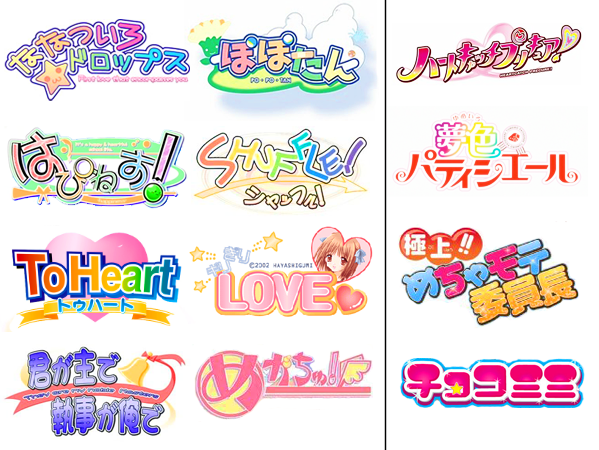
 We return for round two of our analysis of the commonalities of visual novel logo designs. Last time we looked at the similarities of crying girl games. This time we are looking at fun/comedic bishojo visual novels. This was the second type of logo that stood out just as strongly as the sad girls in snow games. They too have this distinct easily recognizable formula to their logo design that instantly tells you what sort of game you are picking up before you see anything else.
 What originally struck me about bishojo game logos was that even though they are marketed for guys, the logos are distinctly what you would image seeing for elementary/middle school girls or you could even image them being drawn by said young girls. This sent me on a quest to compare the two.
These are the happy fun visual novels usually based around comedy. Unlike the crying girl games which are supposed to invoke a feeling of the beauty of sadness these games are supposed to be an energetic tribute to hot girls. And having sex with said hot girls. The lettering of the logo is always big and bold with rainbow colored letters. There is then a subtitle with smaller uniformly colored text but if tends to be just as neon crayon colored as the title itself. The lettering seems to bounce around. Although how asymmetrical it is varies from logo to logo. There is usually a colorful abstract shape in the background and/or mascot along side everything else. The Shuffle! logo is a perfect example with it’s pastel rainbow colored logo, colorful whirlpool in the background and it’s uniformed colored arrow and much less rainbow colored subtitle. Overall I feel that the logo is supposed to invoke a lighthearted festival feeling. They are meant to invoke a fun, energetic, humorous feel. I have to agree 100% with what Narutaki said about the designs looking like they were draw by an artistically talented elementary school student or at least something aimed at said student.
You can click the image above to show more logos and also see a comparison to logos made with young girls as the target audience, more on that in a few. What hits you first when looking at these bishojo game logos side by side is the overall color palette which immediately brings out a light-hearted feel and removes even a remote possibility of worries (unless you’re worried about having too many girls to choose from). Even without the mascot or icon that many like to add in to these designs, there is a sense of fun and energy present. The actual type can vary but it always has a boldness to it and the use of a double stroke, usually a white or light thick stroke around the type followed by a black or dark thin stroke. The color palette here is bright, but when looking at the logos for young girls, you can see they are in the same vein but tend to be more saturated. The visual novel logos are actually more feminine, more girly than the ones actually aimed at girls. If I may be philosophical for a minute, it’s like the difference between what girls are like and what guys think girls are like. But commonalities should be clear including the boldness, the off kilter line of type, and the use of strokes. They actually evoke the same feelings (well, minus all that fan-service)!
I am once again curious if other people agree with our observations or have other good examples to add to our case files. The next one should wrap this series up unless someone wants to provide some examples for different distinct genre design. Please look forward to our next visual novel logo article.
Visual Novel Logos: Part 1 Part 3

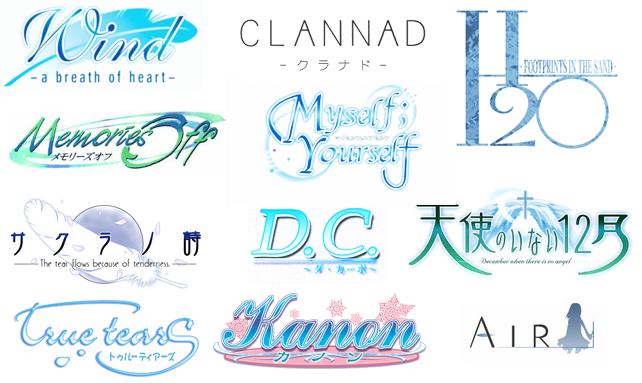
 This all started with a random observation. Narutaki and I were looking over what shows we wanted to sample from the new season of anime. While researching one title we had not heard of we went to the series’ homepage and I instantly knew the anime was based on a
  In a rare, though interesting turn, we take a look at the logos of visual novels purely from the point of view of design. Even though the famous saying is “don’t judge a book by it’s cover,” you can actually tell a lot from them! This is less of a conversation and more of an observation. Unfortunately, we can’t for the life of us remember what that show was that started this whole thing! But thank you show, wherever you are.

 Reverse Thieves