February’s Final Denouement: The mysterious use of screentone in OEL.

Because of a random comment that occurred while looking at pages from King of RPG’s, I found myself taking a closer look at the use of screentone in manga the past couple of weeks. Essentially the comment was that something about the way OEL uses screen tone feels different from manga which it is supposed to be derived from. But what exactly was the difference, well, that required closer inspection, thus I type before you now.

Screentone use in manga I came to feel, or realize, was lending texture, pattern, the idea of color, or providing emphasis or deemphasis as it may be, and even creating mood. The characters themselves were often devoid of tone, except maybe a pattern on their clothing or perhaps their hair, with little shading.
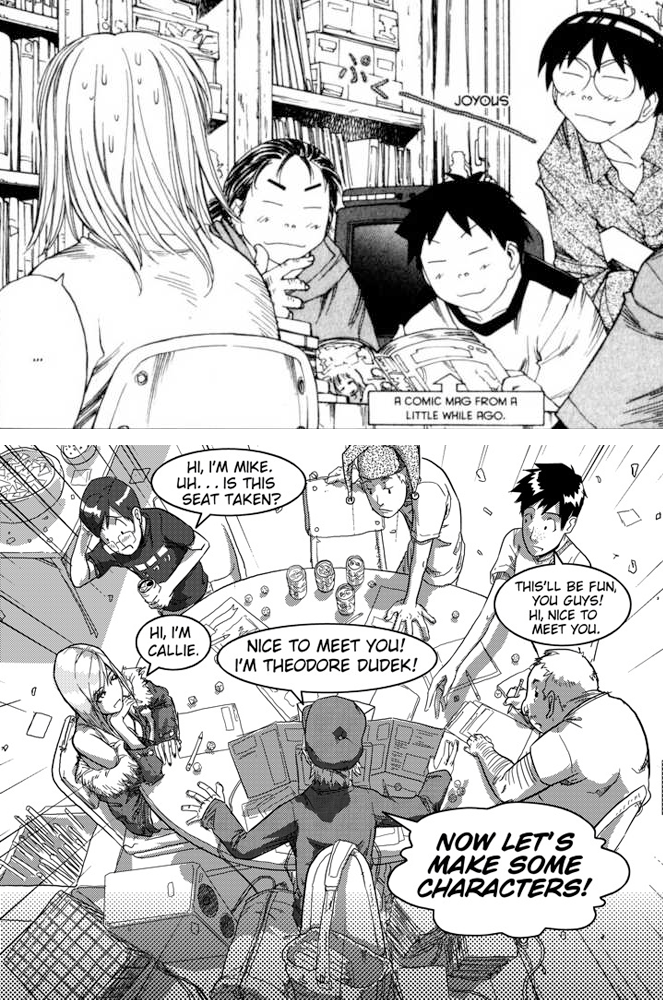
And shading is where I started to feel the difference. Screentone in manga is used more flatly, whereas in OEL there is depth emerging. Characters in the foreground were not being given pattern with screentone, but instead were being shaded extensively with it in OEL. When screentone was showing up in the background of manga, it was more for pushing back the image in order to let the foreground characters pop. It was also lending a mood or feeling to the events occurring on the page. Contrastly in OEL, backgrounds were becoming less abstract with more of an emphasis on perspective. OEL is attempting to create a more multidimensional space using screentone as the central tool.
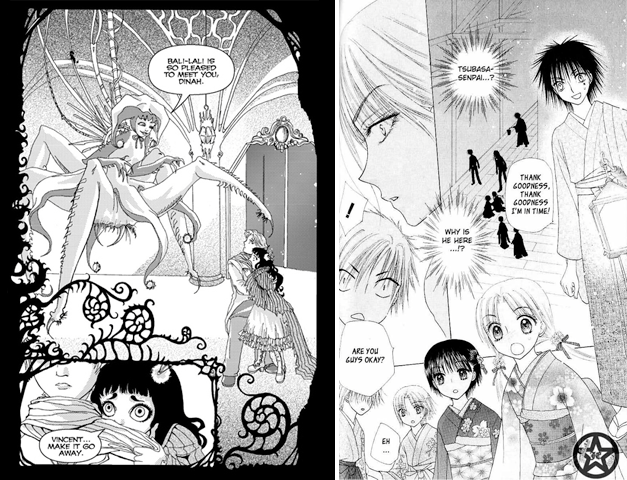
Randomly, I feel that digital screentone is still working the kinks out. This method is quite popular in OEL. I won’t say I can always tell when it is being used, but it can be easier to pinpoint. There is such a crispness to the lines when working completely on the computer that it becomes more obviously manufactured. There is a disconnect from the slight fuzziness that happens when scanning in a work of art.

Since all artists have their own styles and quirks there are always going to be exceptions and incidents here and there. But I think I have come to grasp some of the basic general uses of screentone in manga and OEL and the differences that can be seen. While I can’t say what has caused OEL to move in this direction, perhaps it is just a western emphasis on a more realistic aesthetic. The more I looked, the more I came to find OEL to have this emerging stylization even if only by accident.

The Speakeasy: A Reverse Thieves Podcast – Drink #001

Surprise! Anime 3000 presents: The Speakeasy

If anyone remembers, we had originally planned to make The Speakeasy our monthly rant section on the blog. That became the Final Denouement. The Speakeasy has instead become our monthly podcast. We hope everyone is cool with the change. We know we are super excited! We will being doing a monthly podcast which is generously being hosted courtesy of Anime 3000. The goal is to have a meta-podcast. There are already so many good anime and manga podcasts that review so much that we wanted something a little different. The Speakeasy is going to be a ongoing conversation between the two of us about themes, trends, and concepts present in anime and manga and along side that sometimes there will be a critical analysis of fandom. If you were ever curious about our conversations that are the genesis of our posts then this will be utterly enlightening. If you never wondered about that, hopefully you will still enjoy the show!

Drink #001: Bloody Mary, A discussion of strong female characters
We decided to go back to the roots of the blog for our inaugural podcast. We start off with the initial question: Is anime actually filled with good, strong female characters or is that dream much like a Satoshi Kon movie? The discussion then unfolds as we look at what our initial expectations of strong female characters were when we started watching anime, the realities of the medium, and its future.
(Listen) (Show Notes)

And now your helpful bartenders at The Speakeasy present your drink:

Bloody Mary
* 1 oz. to 1 1/2 oz. (30-45 ml) vodka in a Highball glass filled with ice.
* Fill glass with tomato juice
* 1 dash celery salt
* 1 dash ground black pepper
* 1 dash Tabasco
* 2-4 dashes of Lea & Perrin’s Worcestershire sauce
* 1/8 tsp. horseradish (pure, never creamed)

* Dash of lemon or lime juice
Garnish with celery stalk.

May be shaken vigorously or stirred lazily, as desired. Garnish with a celery stalk; a skewer of olives, pickles, carrots, mushrooms, or other vegetables; or even meat or fish (salami, shrimp, etc.) and cheese. Occasionally, pickled asparagus spears or pickled beans are also used.

Visual Novel Logos Part 2: Bloggers just wanna have fun!

We return for round two of our analysis of the commonalities of  visual novel logo designs. Last time we looked at the similarities of crying girl games. This time we are looking at fun/comedic bishojo visual novels. This was the second type of logo that stood out just as strongly as the sad girls in snow games. They too have this distinct easily recognizable formula to their logo design that instantly tells you what sort of game you are picking up before you see anything else.

What originally struck me about bishojo game logos was that even though they are marketed for guys, the logos are distinctly what you would image seeing for elementary/middle school girls or you could even image them being drawn by said young girls. This sent me on a quest to compare the two.

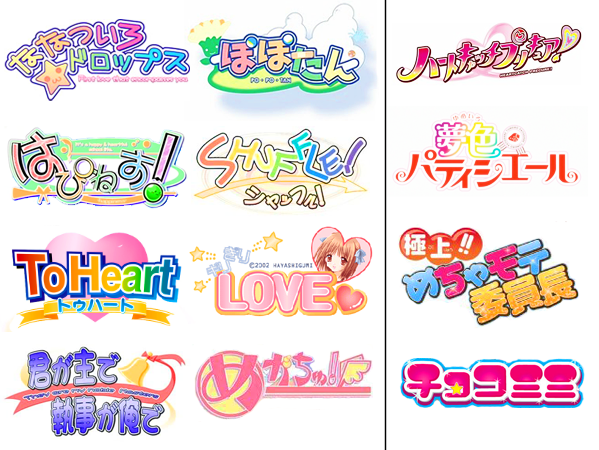
These are the happy fun visual novels usually based around comedy. Unlike the crying girl games which are supposed to invoke a feeling of the beauty of sadness these games are supposed to be an energetic tribute to hot girls. And having sex with said hot girls. The lettering of the logo is always big and bold with rainbow colored letters. There is then a subtitle with smaller uniformly colored text but if tends to be just as neon crayon colored as the title itself. The lettering seems to bounce around. Although how asymmetrical it is varies from logo to logo. There is usually a colorful abstract shape in the background and/or mascot along side everything else. The Shuffle! logo is a perfect example with it’s pastel rainbow colored logo, colorful whirlpool in the background and it’s uniformed colored arrow and much less rainbow colored subtitle. Overall I feel that the logo is supposed to invoke a lighthearted festival feeling. They are meant to invoke a fun, energetic, humorous feel. I have to agree 100% with what Narutaki said about the designs looking like they were draw by an artistically talented elementary school student or at least something aimed at said student.

You can click the image above to show more logos and also see a comparison to logos made with young girls as the target audience, more on that in a few. What hits you first when looking at these bishojo game logos side by side is the overall color palette which immediately brings out a light-hearted feel and removes even a remote possibility of worries (unless you’re worried about having too many girls to choose from). Even without the mascot or icon that many like to add in to these designs, there is a sense of fun and energy present. The actual type can vary but it always has a boldness to it and the use of a double stroke, usually a white or light thick stroke around the type followed by a black or dark thin stroke. The color palette here is bright, but when looking at the logos for young girls, you can see they are in the same vein but tend to be more saturated. The visual novel logos are actually more feminine, more girly than the ones actually aimed at girls. If I may be philosophical for a minute, it’s like the difference between what girls are like and what guys think girls are like. But commonalities should be clear including the boldness, the off kilter line of type, and the use of strokes. They actually evoke the same feelings (well, minus all that fan-service)!

I am once again curious if other people agree with our observations or have other good examples to add to our case files. The next one should wrap this series up unless someone wants to provide some examples for different distinct genre design. Please look forward to our next visual novel logo article.

Visual Novel Logos: Part 1 Part 3