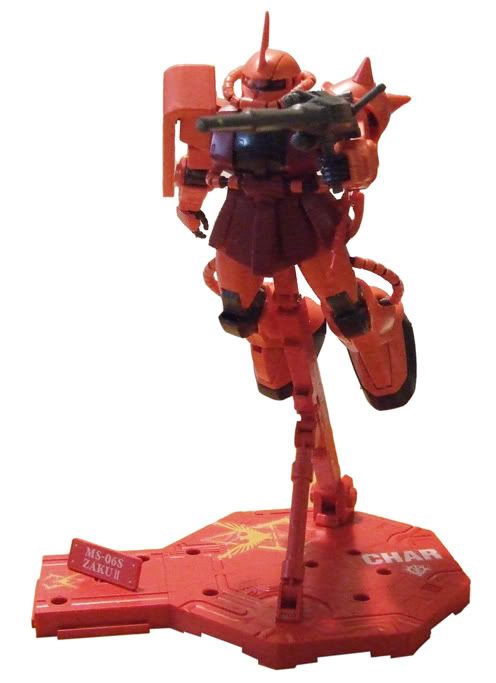
 So I finally got around to building my Char Action Base over the weekend. I was quite surprised that it was in any way complex, I expected to just open up the package and be good to go. Not so. This is probably for maximum customability, there were more stickers in this kit than I think there were in the actual Zaku II Master Grade I built! Both stands can be put in many different positions as well as be lengthened and shortened easily. They are very thick so sturdiness seems in tact though trying to put the Zaku II at a 90 degree angle proved too much for it. In any case, the construction was rather quick and then came the ability to make Char’s Zaku look like it is flying through space! Watch out!
 I don’t think that The Battle of Genryu: Origin is a bad manga though I am not sure it is a good one either. Our main character Jinnosuke has an unusual condition. Most of the time he is a normal clumsily high school student but every so often he get amazing bursts of athletic skill. We comes to find he has tremendous martial arts skill that lies dormant thanks to his family’s hypnotism. Jinnosuke’s older brother, Soichiro comes back determined to awaken this sleeping powerhouse. The fighting is fine and entertaining but not spectacular. Shoko Fukaki tends to use a lot of speed lines and the rest of the art work is serviceable but not outstanding. Jinnosuke is happy go lucky normally but his personality with the power is utterly ruthless. That dynamic is what will make or break this manga, but it is hard to tell which direction it is leaning here. I was somewhat saddened that even though Fusano, Jinnosuke’s girlfriend, is also a martial artist, she is really the utterly weak sauce love interest girl. The first book mostly set up Jinnosuke’s situation so how exactly the whole series is going to play out has yet to be determined so it’s hard to make a definitive statement. However, it’s not a series that is going to win over non-fighting manga fans but people who like martial arts might want to see how it develops.


