
 As someone who writes for a blog that updates at least twice a week, it is extremely obvious that I have a passion about anime and manga. This lends itself to me taking an interest in books that examines anime as well. So when Narutaki was able to get the Rough Guide to Anime for an incredibly low price I was only too eager to review it. The Rough Guide series started as a series of travel guides for backpackers but in 1994 branched out into books that give overviews of various topics. In a way they a pretty much like For Dummies books but with a more rugged title. The book attempts to introduce the reader to what anime is and how unique and versatile it can be.
 When I hear you say that, it makes me think about the people who are buying this book. How many of them are people who have a casual interest in anime and want to understand it better and how many are just bloggers, etc. who grabbed it to see if they find it sufficient. And of course every guide of every thing ever will have people divided on just how good it is and if they writer knows enough to call themselves an authority. But as luck would have it, Simon Richmond isn’t an entrenched otaku himself and so it’s almost a perfect look at what someone with a casual understanding of anime finds significant and interest grabbing.
We start with a brief history of anime going decade by decade to show how the medium started and then how it has changed over the years. The guide then runs down a list of 50 anime that everyone should see. The list is a mixture of TV series, OAVs, and movies with the main focus of being exceptional anime from through out the history of anime. The book then looks at the people who make anime with sections on studios, directors, voice actors, and musicians. It then segues into the various genres within anime with a few notable examples from each genre. The next section is how anime has mixed with other mediums such a live action dramas based on anime, video games crossovers, foreign co-productions, and various parts of anime fandom. The series finishes up with a glossary and a rather large section of links so you can learn more.
What is most important in a guide like this is accessibility, and I think Simon nails that. The breakdown of sections as well as the language therein are casual and without a feeling of bias or superiority. I found the myriad of sections of proper length and depth free for the most part of tangents but nice side notes and boxes for more information on some terminology or a specific incident or show. There is obviously a great deal of time dedicated to Tezuka, as is warranted, but I do feel others needed more focus overall. This is helped somewhat in the call-outs to important names but some times to confusion. For example, Go Nagai is certainly a name to know but why is he in the directors section? I think it would have been best to just have an overall section of influential people. This would have also made the seiyuu and music sections look less neglected.

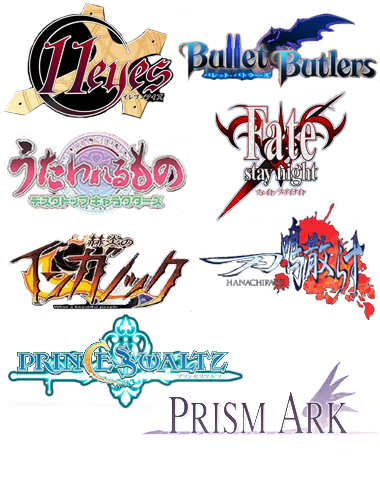
 Round Three visual novel logo designs! In the last two posts we looked at the two most easily spotted designs for visual novels:
  When comparing all three logo posts side by side, it becomes immediately obvious that each approach is very different. And that is what you want to have happen! Logos are meant to tell you something and give you an immediate feel to what you are going to be seeing (using, eating, whatever, etc.). Overall I saw a little more variety in the fantasy visual novel genre but you can see glean some common properties from them. There is a feeling of complexity to these logos that is composed of not only the many pieces involved by each piece having a flair of it’s own.
 Reverse Thieves