
There may be a million and one reasons to interview Ed Chavez. We’d go as far as to say he’s one of the leading experts in all aspects of manga in America. He has been a freelance translator for a variety of American manga companies. He does a decent amount of blogging and podcasting at The Mangacast. He has had the extremely enviable but demanding job as an assistant editor for Kodansha in Japan. He has probably met and talked with more manga-ka than normal manga fans could even name. He has nearly an encyclopedia of knowledge about the world of manga and the intricacies of manga theory as well. And finally, he is currently the head of marketing at Vertical Inc. As Vertical has recently announced that they were unveiling a whole new line of manga we thought it a perfect time to talk with Ed. Although Vertical has done several extremely well regarded Tezuka manga and other classics, they recently decided to expand their focus with their latest acquisitions. What emerged was an extremely diverse new selection of titles. We asked Ed about how he is settling into his job, his views on manga, the new titles, and Vertical’s plans for the future.
Reverse Thieves: Just tell us a bit about how you came to Vertical first.
Ed Chavez: Let’s see how long has it been? I officially started on May 1st so that’s 6, a little more than 6, months. But I was in the office as of April 20th of this year [2009]. Vertical as a company did not have a marketing department at the time. There was around a 4 to 6 week period where there was just nobody. Our sales director had also gone back to Japan around the same time. The company as a whole had started to shrink so much that they needed to hire more staff. According to my boss Yani [Mentzas], he was considering me for a little while. We did like an informal interview/dinner at this year’s [2009] New York Comic Con. He kind of scouted me out and tested my proficiency on a number of levels, personality-wise and language and things like that. Some of the things he was already familiar with because of my previous writing, and he knew I had done work at CMX and for other publishers, as well as my work for Kodansha. And so I filled a hole that we had with staff and it also allowed the company an opportunity to fulfill a promise they had been teasing with for a while and thats the expansion of their manga line. They have been discussing it, at least publicly for a year and half, two years, before I joined.
RT: So expanding the manga line wasn’t spontaneous.
EC: Oh, no, not at all. I think they would have done so sooner had they found a licensing partner. Which we still don’t have. And if the economy was a little better. In general we don’t release a lot of long series, Black Jack is an exception, but once you get towards the really popular titles, they tend to be a little longer. So licenses can cost a pretty penny and for a small publisher like us, it’s a little hard if we don’t have the money. And with the economy being what it was last year [2008] and the beginning of this year [2009], it kind of derailed things.
RT: With such a small staff, you seem to be a man of many hats at the company.
EC: This is actually my first marketing position. Right now, I take care of all sorts of things not just of marketing. Like the sales data kind of thing. Random House does our actual sales, they’re our distributor. I have a part in licensing, research and development, office management, publicity, advertising, that social networking thing that has to be done by somebody. I have to find an intern who wants to do that! [laughs] Not interns that know it exists, and do it on their own, but who want to do that for us. They can hang out on the computer all they want! Then I could focus on something else.
EC: I guess I should also say, I do a little bit of editing. I won’t give myself that hat right now. But I do go over everything we release except the cookbooks, oh and the craftbooks which are generally straightforward enough. But I do look over every translation and edit that my editorial staff does. You know, I’m there with a medical dictionary looking up training terms for Black Jack and stuff like that and other little details. I do this with the prose books we release as well. It’s just some additional quality control I guess. I do a little translation work also. That’s about it. Oh, there’s always events and the wrangling of authors when they come to town. It keeps me relatively busy.
RT: Since you’re coming into marketing without any formal background in it, how have you found the position? What kind of expectations did you have?
EC: It’s hard to answer early on. If I had a budget, I think my expectations would be different. I would be doing ads, we wouldn’t just have promotional material concepts, we’d have actual promotional material. [laughs] It’s not that we won’t next year, but the closer we get to the release dates of some of our titles, the more reluctant I am to actually spend that money. My concern is to build-up something ahead of time and then try to get some word of mouth. Now obviously we do send out review copies of our backlist so people can be aware that we are releasing other books. And I make mention of those reviews just so people can know that A Rabbit’s Eyes is cool and that somebody just reviewed The Cage. And everytime someone mentions Buddha, even though it’s sold more than 100,000 units combined, it’s always good to keep the flame going. But it would be nice to see what actual promotion does to a book. In comparison to publicity. And what I mean by that is outside of reviews and word of mouth; not what the public says, but what we would like to have heard. For me, it is a little frustrating because I know we have done that in the past and I haven’t really been asking what the budget was back then, but literally having a zero dollar budget makes things very complicated.
EC: When I go to events and I see that people respond well to what I say, or what the company presents to the public, that’s actually surprised me quite a bit. I don’t think we do anything better, or do anything fancier, or put in any more money or resources than our competitors do, but I like to think that we do more with less in those situations. And in the time I’ve been around, and meeting with public, the response has been really positive but I haven’t necessarily seen that correlate to sales outside of events. At events I can sell out of almost everything we’ve got. And that is good, especially looking at our numbers from past events. But in actual bookstore numbers, or when looking at Amazon or Diamond, who knows. It has improved the situation with our distributor and vendors. We can direct them to the excitement, and we get more requests for books but we are still selling about the same number of books. At least things aren’t going down! Our limitations are pretty heavy.
EC: Coming in with no experience . . . Well, when I was at CMX I was doing a little marketing but just some things online outside my editorial duties. But it’s the non-personal stuff, the stuff that is not about interacting, that I had the least amount of experience with but I feel I have a better understanding of that now. And that is figuring out who your readership is, demographics, where people are buying, and then manipulating that. I have figured that much out, but how to best do that is tricky.
RT: When you say manipulating, you mean capitalizing on a group or expanding it, or both?
EC: Manipulating, I chose that word because it is both positive and negative. It is very much capitalizing on things and marketing is always about an endgame. How you get there isn’t always going to be clean.
RT: What is Vertical’s mission statement for the new manga line?
EC: [laughs] I don’t know if there is one to be honest! When we initially, or really Yani and Vertical at the time, were trying to launch it was to move towards more contemporary titles. They were saying they would like to have a line up of titles that had anime properties on the Cartoon Network, when that network was still doing anime. So that can tell you how long they’ve been thinking about this. Television patterns have changed and the anime industry has changed a lot in this country though. But in general it [the new manga line] is about finding some of the best stuff that’s out there right now. One thing that has changed is because of all the partnerships that have been built up like Square Enix and Yen Press, Mag Garden and Tokyopop, Shueisha and Shogakukan and Viz, Kodansha and Del Rey and now Kodansha USA being here, it’s harder and harder to find new publishers to work with. So to work within that structure we have decided to focus not on necessarily mainstream genres and we’ll continue to do that. That is to say not a focus on your standard shonen and shojo categories. In the future, who knows, we might get those opportunities again. We’ve had shojo and shonen titles before but in general the manga industry out here has not gone outside of those two too much. So we feel we have a wide open playing field when it comes to seinen and josei and maybe even some experimental or alternative titles and even some titles people might consider to be adult. There are a number of things we are considering. We aren’t going to be limited to the classical titles, we’ll still be releasing them, but what we are tying to find are good titles, challenging titles, titles that are analogous to what we do with our prose.

 I had trouble putting into words how I felt about
  I picked up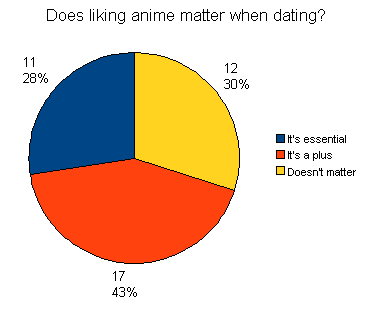
 We start off the new year with what everyone is really reading the otaku diaries for: dirty sex secrets. Who is doing what to whom and if farm animals are involved. Well, actually, that is no where near what this part is about. This is mostly a look at the romantic relationships or lack thereof of the various participants. Like it or not there is a stereotype that otaku are mainly lonely, dateless losers who know more about how to win hearts in visual novels than they ever will about talking to a member of the opposite sex. But the survey found a wide variety of people answered from hardcore 2D girl proponents to those who were happily married to love em and leave em Lotharios. The only commonality most people had was that their stories were always extremely emotionally involving.
 The answers in this section may be the most varied of them all. Our group of participants ran the gamut from new to the dating scene to downtrodden, rejection of dating to belief in true love, and still much more inbetween. And what resulted were answers that certainly are very personal but still they will resonate, some views more than others, but very much every type of person can be seen here. Heck, this may be the portion of the survey that goes to show most how much fandom is a mix of many different types of people.

 Reverse Thieves